Do Air Fryers Use a Lot of Electricity
Somebody in your house has an opinion about this. Either the air fryer is a money-saving miracle, or it is why the bill went up. Both camps argue from the same missing number: nobody checks what the machine actually draws while it runs.
The short answer
No. An air fryer is one of the cheapest hot appliances in a normal kitchen to run, and swapping a full-size oven for it on a small meal saves roughly ten cents. Do that once a day and you are looking at something like forty dollars a year.
That is the honest size of the prize: real money, but not the transformation the internet promises, and it disappears the moment you cook in two batches. The rest of this page shows the arithmetic so you can redo it with your own rate, which matters far more than any national average.
Watts are not the bill
Here is where nearly every online estimate goes wrong. People read the number stamped on the back of the machine, typically 1,200 to 1,800 watts, multiply it by the cooking time, and announce a cost. That overstates the answer badly.
The nameplate wattage is a ceiling, not an average. The element runs flat out to reach temperature, then cycles on and off to hold it while the fan keeps running, so the machine spends much of a cook drawing very little. What lands on your bill is the kilowatt-hour, and you cannot get there from the nameplate. You need somebody with a meter.
What the meter says
The UK consumer group Which? put a Morphy Richards air fryer and a Bosch built-in electric oven through the same four dishes and published the energy each used, preheating included. Those kilowatt-hour figures are theirs. The average-draw columns below are ours: energy divided by time, which gives the power the appliance actually pulled while switched on.
| Dish | Air fryer energy | Air fryer average draw | Oven energy | Oven average draw |
|---|---|---|---|---|
| Roast chicken | 0.54 kWh in 53 min | about 610 W | 1.157 kWh in 76 min | about 915 W |
| Chips | 0.287 kWh in 23 min | about 750 W | 0.863 kWh in 33 min | about 1,570 W |
| Jacket potato | 0.392 kWh in 48 min | about 490 W | 1.084 kWh in 68 min | about 955 W |
| Cake | 0.223 kWh in 33 min | about 405 W | 0.71 kWh in 56 min | about 760 W |
Look at the roast chicken. A machine rated well over 1,400 watts averaged around 610 while it cooked. Any calculator that told you 1,400 watts for 53 minutes overstated the energy by more than double.
The same thing happens to the oven. Rated in the thousands of watts, it averaged well under 1,600 on every dish. The oven is not a power monster minute by minute; it loses on total energy, because it heats a far larger cavity and stays on longer to do it.
What it costs in dollars
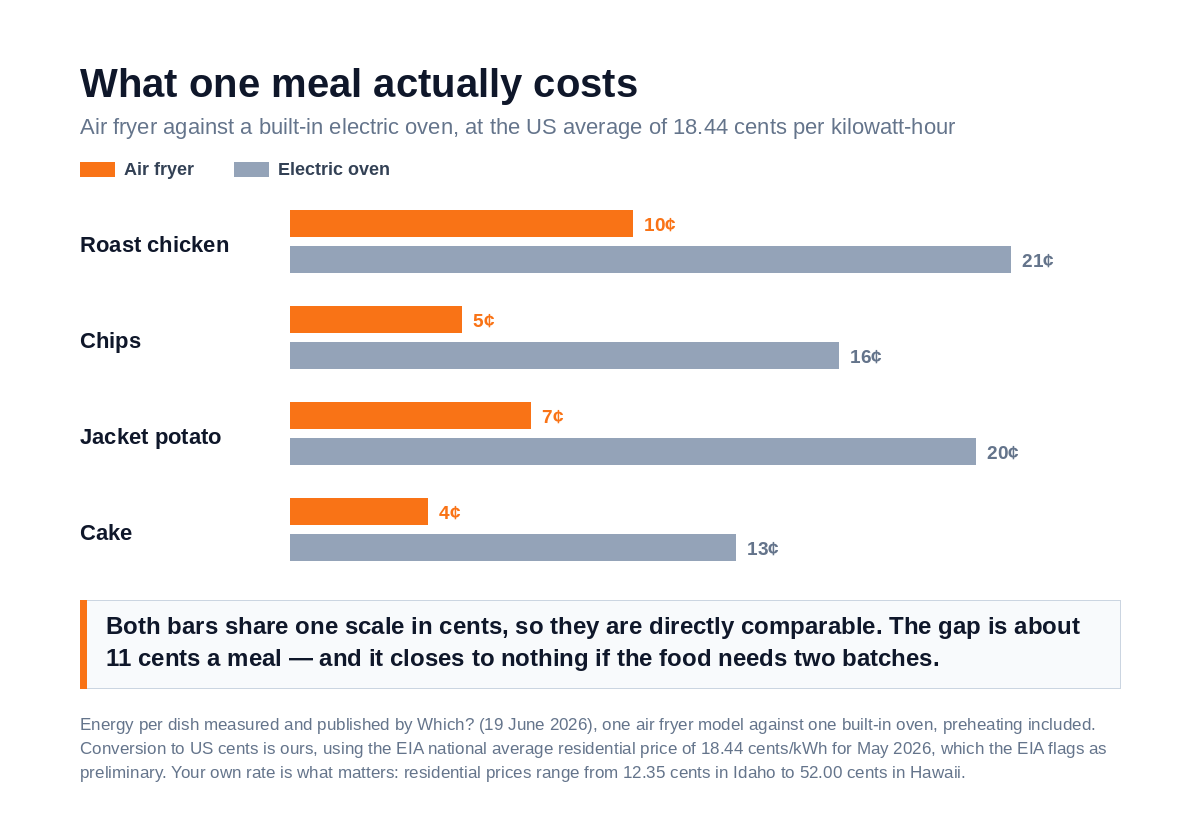
Kilowatt-hours cross borders; prices do not. The US Energy Information Administration puts the national average residential price at 18.44 cents per kilowatt-hour for May 2026, which it flags as a preliminary estimate. Applying that rate to the energy figures above gives the following.
| Dish | Air fryer | Electric oven | You save |
|---|---|---|---|
| Roast chicken | 10¢ | 21¢ | 11¢ |
| Chips | 5¢ | 16¢ | 11¢ |
| Jacket potato | 7¢ | 20¢ | 13¢ |
| Cake | 4¢ | 13¢ | 9¢ |
Around eleven cents a meal. Swap one oven meal a day for a year and you save about forty dollars.
A separate body arrives in the same neighbourhood by a different route. The Energy Saving Trust, using lab testing on specific foods, gives the typical cost to cook a 600g chicken breast as £0.14 in Great Britain (GB) and £0.18 in Northern Ireland (NI)
against £0.20 in GB and £0.25 in NI
for an electric oven. Different country, different tariff, different appliances, still a gap of pence rather than pounds. Two independent tests landing on the same order of magnitude is worth more than either alone.
Your rate matters more than the average
The word average is doing a lot of quiet work in that forty-dollar figure. Inside the same EIA table, residential prices run from 12.35 cents in Idaho to 52.00 cents in Hawaii. That is a fourfold spread, and it means the identical swap is worth wildly different amounts depending on where you plug the thing in.
Take the roast chicken, where the air fryer used 0.617 kWh less than the oven. In Idaho that saves about 8 cents, or roughly $28 a year on a daily swap. In Hawaii the same 0.617 kWh is worth about 32 cents, or roughly $117 a year. Same appliance, same meal, four times the benefit.
One wrinkle deserves stating rather than smoothing over. The Bureau of Labor Statistics tracks a similar figure through the Consumer Price Index and had it at 19.8 cents per kilowatt-hour for June 2026, above the EIA’s 18.44. Neither is wrong; they are built from different data. The disagreement between two federal series is the best argument for ignoring both and reading the rate off your own bill.
When the saving vanishes
Everything above assumes the meal fits in the basket. Once it does not, the maths inverts, and the science team leader at Which? says so plainly: The air fryer often used less than half the energy, and the results were just as tasty. However, the savings soon drop off if you have to cook in batches, so an oven may still be the most economical choice when cooking for a crowd.
Run the roast chicken twice and the air fryer has spent 1.08 kWh against the oven’s 1.157. The advantage is essentially gone, and you have spent an extra hour to get there. A third batch and the oven simply wins.
So the honest energy question is not which appliance is efficient but how much food do I cook at once. The Energy Saving Trust agrees from the other direction: the oven’s size makes it better for batch cooking or feeding a group. If you routinely cook for four, saving electricity is a poor reason to buy an air fryer. There are better ones, and it is worth knowing before you shop for a capacity that suits your household.
Cramming the basket to avoid a second batch is not a clever workaround either. The USDA’s Food Safety and Inspection Service is direct about the consequence: Overcrowding the appliance can prevent enough air circulation to properly cook the food.
Undercooked chicken is a considerably worse outcome than eleven cents.
Four habits that actually move the number
- Stop opening it. Both bodies give the same tip independently: every look lets out hot air the machine just paid to make.
- Use it for the meals it suits. One or two servings is where the gap is widest; a full oven load is where it closes.
- Skip the preheat when the recipe allows. Small chambers reach temperature fast, and much of the advantage above comes from less total time hot.
- Keep the element and basket clean. Baked-on residue absorbs heat and smokes, and it is the usual reason a machine starts smoking. Our guide to cleaning the heating element covers the part most people never touch.
What this article cannot tell you
- What your specific model uses. These figures come from one air fryer and one oven.
- Standby draw. We found no measurement we trust for what an air fryer consumes sitting idle with the display lit, so we are not going to estimate one.
- Gas oven comparisons. Both tests used electric ovens. Gas is priced per therm and the comparison is a different calculation entirely.
- Whether a bigger air fryer costs more to run. Neither source separated capacity from energy use.
- Whether basket or oven-style is cheaper. The Which? test compared an air fryer against a built-in oven, not the two air fryer shapes against each other. Anyone quoting those pence figures as a basket-versus-oven-style result is stretching them past what the test did.
Frequently asked questions
Will an air fryer noticeably raise my electricity bill?
Not on its own. Even daily use lands in the range of a few dollars a month at average US rates. If your bill jumped after buying one, heating, cooling or a failing refrigerator are far more likely culprits.
Is a higher-wattage air fryer more expensive to run?
Not necessarily. A more powerful element reaches temperature sooner and may finish the dish faster, so it can use fewer kilowatt-hours despite the bigger label. Wattage tells you how hard it can push, not how long it will need to.
Do air fryers use less electricity than a microwave?
No. The Energy Saving Trust puts a 400g ready-made lasagne at £0.04 in GB and £0.05 in NI
in a microwave, because a microwave heats the food directly rather than the air around it. For reheating, the microwave wins on energy every time. It just will not crisp anything.
Should I unplug it between uses?
The Energy Saving Trust suggests switching small appliances off at the plug. We have not seen a figure for what that saves on an air fryer specifically, so treat it as general good practice rather than a measurable saving.
How do I work this out for my own machine?
Put a plug-in energy monitor between the air fryer and the wall, cook something you cook often, and read the kilowatt-hours off the display. Multiply by the rate on your bill. That number beats every estimate on this page, including ours.
Related reading
- What size air fryer do you actually need? — capacity decides whether you batch, and batching is what kills the saving.
- Basket vs oven-style air fryers
- Why is my air fryer smoking?
- How to clean an air fryer heating element
- When should you replace an air fryer basket?
- How we research
Sources: Which?, Air fryer vs oven: energy usage, costs and cooking results compared (19 June 2026); Energy Saving Trust, Air fryer vs oven: which cooking appliance is cheaper to run? (last updated 21 August 2025); US Energy Information Administration, Electric Power Monthly, Table 5.6.A (data for May 2026, released 23 July 2026); US Bureau of Labor Statistics via FRED, Average Price: Electricity per Kilowatt-Hour, US City Average (June 2026); USDA Food Safety and Inspection Service, Air Fryers and Food Safety (updated 24 June 2024). Cost conversions from kilowatt-hours to US cents, and all average-draw figures, are our own arithmetic on the published data.