Can You Put Aluminum Foil in an Air Fryer?
Short answer: it depends on your machine, and the manufacturers genuinely disagree with each other. Ninja says foil in the basket is safe. Philips says do not do it at all. Neither is being careless — they are describing different appliances. So the first step is not to ask the internet, it is to open your own manual. If your manual permits foil, there is a second question almost nobody asks: what you are cooking matters as much as whether the foil fits.
What the manufacturers actually say
This is not a case of one cautious brand and one relaxed brand. These are flatly contradictory instructions published by the companies that built the machines.
| Source | Position | In their words |
|---|---|---|
| Ninja (SharkNinja), DZ200 series FAQ | Permitted | Yes, it is safe to use aluminum foil in the baskets. |
| Philips, Airfryer support | Not recommended | No, using baking paper and tin foil in your Philips Airfryer is not recommended. |
| Consumer Reports, independent testing | Check the manual | So it’s not exactly cut-and-dried. Check your manual first. |
Consumer Reports is the useful tiebreaker here, because it looked across a range of models rather than defending one product line. Its finding was that the instructions themselves are inconsistent: while the manuals for some of the models in our air fryer ratings do not mention the use of foil at all, some advise not to use aluminum foil in any part of the air fryer.
If your manual is silent, you have not been given permission — you have been given nothing.
Why Philips says no
Philips is unusually specific about its reasoning, and the three reasons it gives are worth reading closely because they apply to any air fryer, not just theirs.
- Blocked airflow under the food.
If you cover the bottom of the basket, the airflow inside the airfryer is reduced. This results in a diminished cooking performance of your Philips Airfryer.
- Blocked drainage in the drawer.
If you put baking paper or tin foil in the bottom of the pan where the grease and dirt are collected, the airflow will be disrupted and you will not get a good cooking result.
- Loose foil reaching the element.
If you put baking paper or tin foil in your Philips Airfryer without placing food on it, the baking paper or tin foil could be sucked into the heating element and start to burn.
Note that only the third reason is a safety issue. The first two are cooking-quality issues. That distinction matters: a lot of the alarm online treats every foil problem as a fire risk, when most of the time the real consequence is soggy food.
Consumer Reports describes the same airflow mechanism from the engineering side. Larry Ciufo, the test engineer who oversees its air fryer testing, explains that Manufacturers design the inner basket with small slots or holes so the hot air can flow around the food easily and allow for any drippings or fat to fall into the catch pan below it.
Cover those slots and you have converted your air fryer into a small, slow, badly ventilated oven.
Bruce Weinstein, author of The Essential Air Fryer Cookbook, puts the practical result plainly: Lining the basket will block all airflow under and around the food, so the bottom will not get crunchy. And moisture and fat will pool around the food, causing it to get soggy at the bottom.
Pooling fat is also the single most common reason an air fryer starts producing smoke, which we cover separately in why is my air fryer smoking.
The question almost nobody asks: aluminium in the food
Even if your manual permits foil, there is a second and completely separate issue. Aluminium migrates from foil into food, and how much depends less on the appliance than on what you are cooking.
The European Food Safety Authority established a tolerable weekly intake for aluminium in 2008 of 1 mg per kg of body weight per week, covering all sources combined. EFSA was blunt that this is not a comfortable margin: the panel estimated that intakes of aluminium may exceed the TWI in a significant part of the European population
. Its exposure figures put mean adult intake at 0.2 to 1.5 mg/kg per week, and the highest childhood exposures at 0.7 to 2.3 mg/kg per week.
Germany’s Federal Institute for Risk Assessment (BfR) reaches the same conclusion from its own national data: On average, the majority of the population, especially adolescents and adults, already consume half of the tolerable weekly intake (TWI) of 1 mg aluminium per kg of body weight through food.
In other words, roughly half your allowance is already spent before any foil enters the picture.
The mechanism is chemical, not thermal. BfR states that Aluminium is soluble under the influence of acids or salt
, and gives a direct instruction: aluminium foil should not be used to wrap sour or salty foods.
Its named examples are cut apples, tomatoes, rhubarb, salted herring, marinated fish and cheese. BfR is explicit that Aluminium foils are not suitable or intended for storing, heating or keeping warm acidic or salty foods and dishes.
| Food type | Foil contact | Why |
|---|---|---|
| Tomato, citrus, vinegar, rhubarb, cut apple | Avoid | Acid dissolves aluminium into the food |
| Heavily salted or brined food, marinated fish, cheese | Avoid | Salt dissolves aluminium into the food |
| Plain meat, potatoes, most vegetables | Lower concern | Neutral pH, far less migration |
For context on the scale involved, the Council of Europe recommends a release limit of 5 mg of aluminium per kilogram of food for metal articles — though BfR is careful to note that Resolutions are only recommendations and do not contain legally binding limit values.
One thing worth stating clearly, because the internet gets it wrong constantly: on the Alzheimer’s question, EFSA’s panel did not consider exposure to aluminium through food to present a risk for developing Alzheimer’s disease.
BfR agrees that According to current information, a connection is unlikely
, while noting the data remain inconsistent. The real reasons to limit aluminium intake are effects on the nervous system, bones and kidneys with long-term accumulation — not dementia scare headlines.
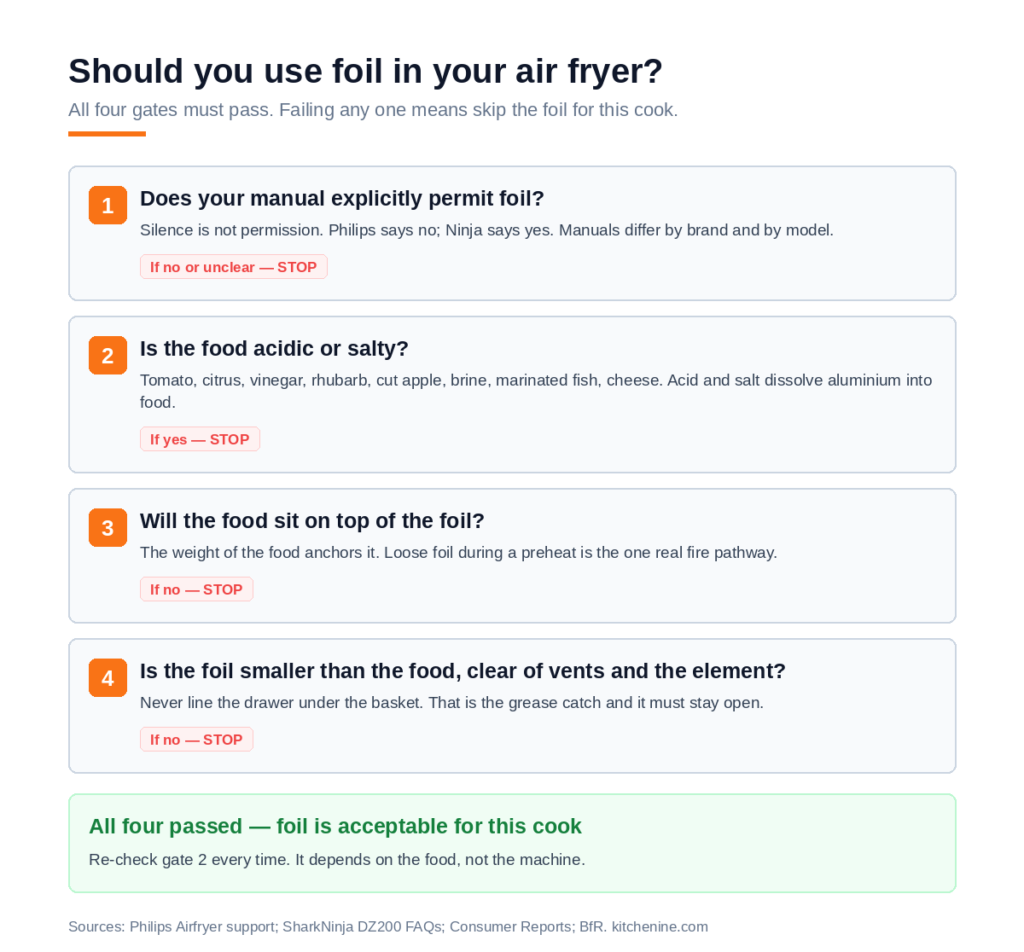
If your manual permits foil, use it like this
- Never preheat with empty foil inside. This is the one genuine fire pathway. Loose foil with nothing holding it down gets lifted by the fan into the element.
- Always put the food on top of the foil so its weight anchors it before the fan starts.
- Keep the foil smaller than the food. Consumer Reports advises matching foil to the shape of the food so that it is
only a smidge larger than the actual dish.
- Never line the drawer underneath the basket. That is the grease catch area and blocking it defeats the drainage the design depends on.
- Never let foil touch the heating element, and never cover vents.
- Skip foil entirely for lightweight foods — anything the fan can move will drag the foil with it.
- Skip foil for acidic or salty food, per BfR, regardless of what the appliance manual says. That is a food chemistry rule, not an appliance rule.
Rule seven is the one that catches people out, because the two authorities are answering different questions. Your manual tells you what is safe for the machine. A food safety regulator tells you what is safe for you. Both have to pass.
Is there a better option than foil?
If your goal is easier cleanup rather than wrapping food, foil is solving the wrong problem. The mess in an air fryer is mostly baked-on grease, and the fix for that is cleaning technique, not a liner. Our guides on cleaning the heating element and when to replace the basket cover that ground properly.
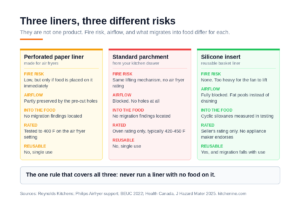
Perforated parchment liners and silicone baskets are widely sold as alternatives, and perforation does address the airflow objection in principle. We are not going to endorse them here, because we could not find a manufacturer or regulator that tests and approves them for this use — and notably, Philips groups baking paper together with foil in the same refusal. If your own manual names a specific accessory, that is the accessory to buy.
What this guide cannot tell you
- Whether your specific model permits foil. Instructions differ by brand and even by model line within a brand. Only your manual answers this.
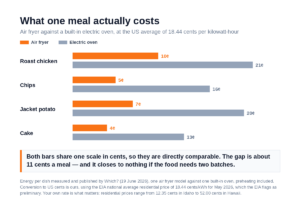
- How much aluminium actually ends up in one air-fried meal. Published migration studies use ovens and grills, not air fryers. We found no air-fryer-specific migration measurement.
- Whether perforated liners are safe in machines that ban foil. No manufacturer we could read has tested this.
- Why Ninja and Philips disagree. Neither publishes the engineering reasoning behind its position, so any explanation we offered would be speculation.
- What KitchenAid, Maytag and Cosori say in full. Their pages would not load for us, so we have not quoted them.
Frequently asked questions
Can foil cause a fire in an air fryer?
The realistic pathway is loose foil being lifted into the heating element, which Philips describes directly: unweighted foil could be sucked into the heating element and start to burn.
Foil held down by food is a far smaller risk than foil floating free during a preheat.
My manual does not mention foil at all. Does that mean it is fine?
No. Consumer Reports found that silence is common and does not indicate approval. Contact the manufacturer if you want a real answer for your model.
Is it worse at higher temperatures?
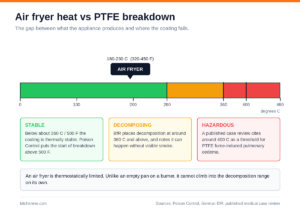
Temperature increases aluminium migration, but acidity and salt matter more. BfR frames its warning around acid and salt content, not heat. Note that air fryers are thermostatically limited and typically operate around 160–200 °C, well below oven-broiler conditions.
Does the shiny side versus dull side make any difference?
Not for safety. The difference is a by-product of manufacturing and no regulator or manufacturer we read distinguishes between the two sides.
Can I use foil to stop food sticking to a worn basket?
Treating a symptom of coating failure with foil hides a problem you should be assessing directly. See is air fryer non-stick coating safe and when to replace the basket.
Related reading
- Why is my air fryer smoking?
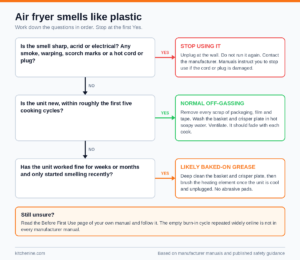
- Why does my air fryer smell like plastic?
- Is air fryer non-stick coating safe?
- How to clean an air fryer heating element
Sources: Philips Airfryer support; SharkNinja DZ200 series FAQs (25 August 2025); Consumer Reports (31 January 2022); EFSA opinion on aluminium from dietary intake (15 July 2008); BfR FAQs on aluminium in food (20 July 2020). Our method is described in how we research.