Why Does My Air Fryer Smell Like Plastic – and Is It Dangerous?
Your air fryer is new, you switch it on, and within two minutes the kitchen smells like a warm toy. It is one of the most common complaints about a brand-new air fryer, and the honest answer has two halves: usually it is harmless, and occasionally it is a reason to unplug the unit and stop.
Those two situations smell similar from across the room. This guide explains how to tell them apart, what the manufacturers actually instruct, and what the evidence says about the non-stick coating that worries most people asking this question.
The short answer
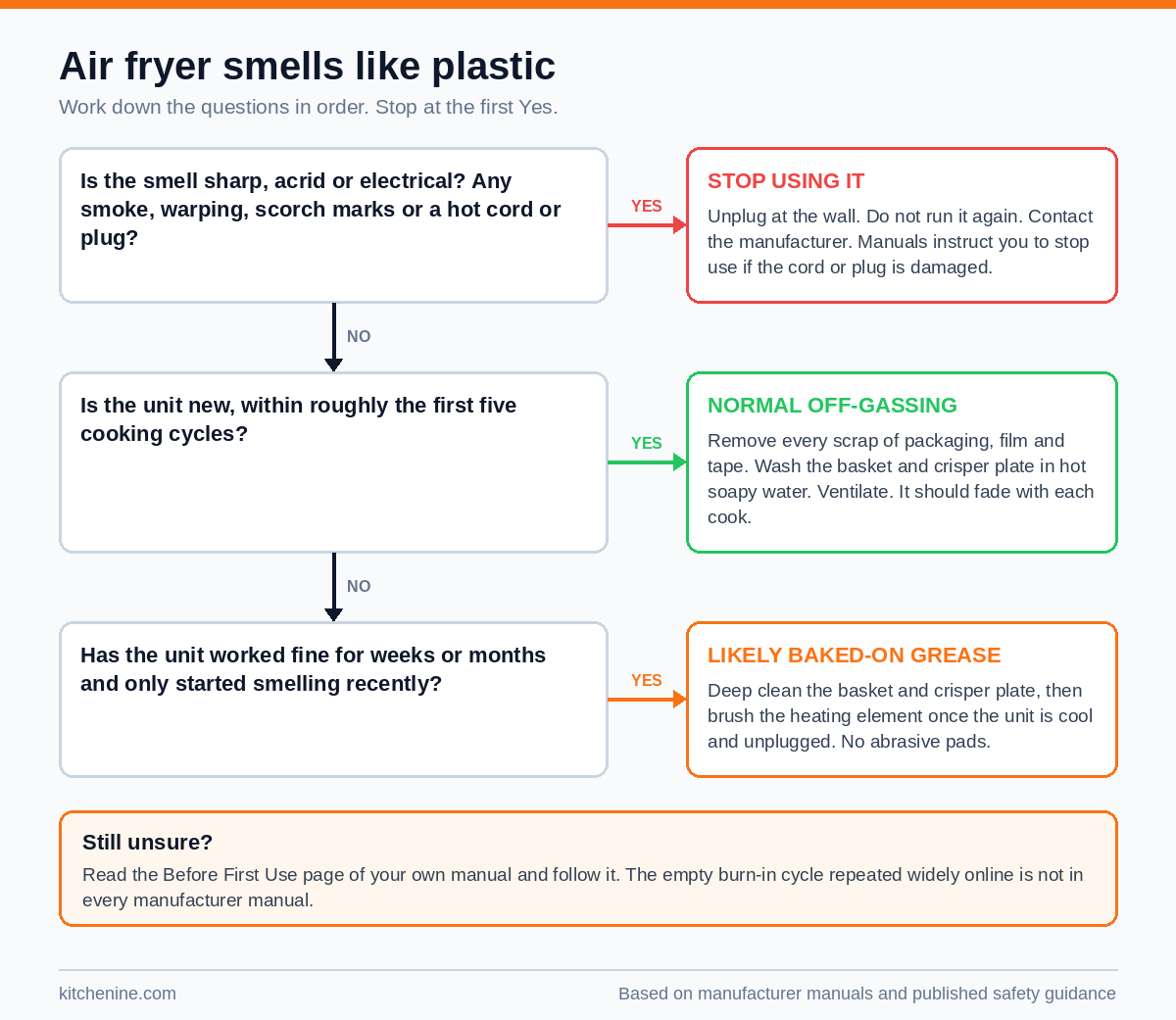
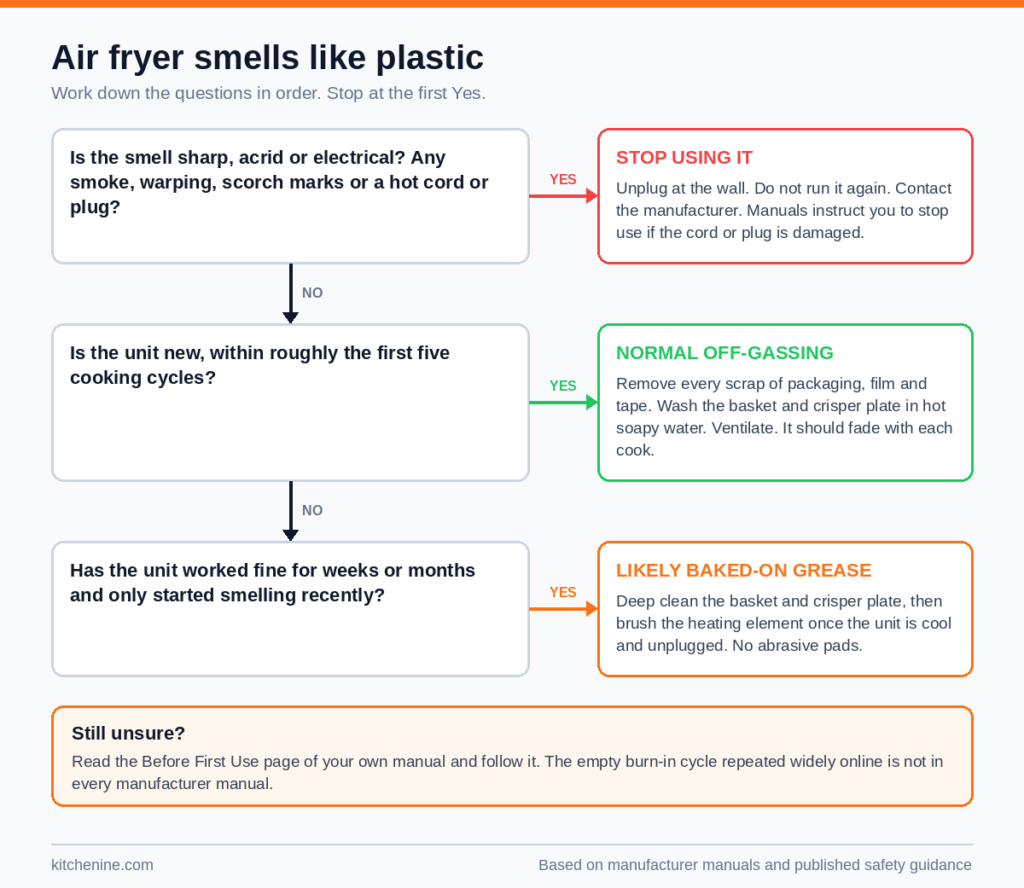
If the unit is new and the smell is faint, warm, and weaker on each use, it is almost certainly normal. New appliances give off residual odour from manufacturing oils, protective films, and heat-resistant plastics reaching cooking temperature for the first time. It typically fades within the first few cooks.
If the smell is sharp, acrid, or electrical — or if it appears suddenly on a unit you have used for months — stop and unplug it. That is a different problem, and the safeguards in manufacturer manuals are unusually direct about it.
Anyone can tell you the first half. The second half is the part worth reading carefully.
What actually causes the smell
1. Packaging material left inside the unit
This is the first thing to rule out because it is the easiest to miss and the most likely to produce a genuine burning-plastic smell. Air fryers ship with protective film, foam inserts, tape, and promotional labels, and some of it sits inside the drawer or against the housing.
The Ninja AF100 series owner’s manual opens its Before First Use section with exactly this instruction: Remove and discard any packaging material, promotional labels, and tape from the unit.
The same manual separately warns against covering the air intake or outlet vents, since blocking them may damage the unit or cause it to overheat.
A scrap of film resting against a hot surface smells like melting plastic because it is melting plastic.
2. Normal off-gassing on a new unit
Manufacturing residues and heat-tolerant components release a faint odour the first several times they reach cooking temperature. This is common enough that Philips maintains a dedicated support page titled There is a plastic smell coming from my Philips Airfryer, and Cosori publishes guidance on the same question.
The defining characteristic is that it weakens. A new-unit smell that is noticeably milder by the fourth or fifth cook is behaving the way it should.
3. Baked-on grease and food residue
If the smell shows up after weeks or months of use, it is usually not the appliance at all. Oil splatter and food debris accumulate on the crisper plate, the basket, and especially the heating element directly above the food, where they scorch on every subsequent cycle.
Cosori’s own cleaning guidance attributes recurring odours to grease and food buildup, and the Ninja manual includes a step most owners never perform: Clean the heating element with a cleaning brush to remove any food residues.
The element is the hottest surface in the machine and the one people are most reluctant to touch.
4. Something is genuinely melting or failing
This is the minority case, and it is the reason this article exists. A damaged cord, a failing component, or plastic in contact with a hot surface produces a smell that is qualitatively different: sharp rather than warm, often described as acrid or electrical, and it does not fade.
How to clear a normal new-unit smell
- Unplug the unit and inspect it. Check inside the drawer, under the crisper plate, behind the basket, and around the vents for film, foam, tape, or labels.
- Wash the basket and crisper plate properly. The Ninja manual specifies hot, soapy water, then rinse and dry thoroughly. Check whether your model’s parts are dishwasher-safe; the AF100 manual says its basket, crisper plate, and accessories are.
- Wipe the main unit with a damp cloth only. Never immerse the housing and never put it in a dishwasher.
- Clean the heating element with a soft brush once the unit is completely cool and unplugged.
- Do not use abrasive cleaners, steel wool, or scouring pads. The Ninja manual prohibits them outright, and there is a second reason to take this seriously that we cover below.
- Ventilate the kitchen for the first few cooks. Open a window or run the extractor. This does not shorten the off-gassing, but it keeps the odour out of your food and out of the room.
A note on the “run it empty to burn it off” advice
The most widely repeated fix online is to run the air fryer empty at maximum temperature for fifteen to twenty minutes. We want to be straightforward about this one.
That instruction does not appear in the Before First Use section of the Ninja AF100 manual, which lists three steps and none of them is an empty heat cycle. Separately, Germany’s Federal Institute for Risk Assessment (BfR) advises that PTFE-coated cookware should therefore never be heated when unfilled.
That BfR guidance is written about stovetop pans, where a gas or induction burner can drive an empty pan far past the decomposition point within minutes. An air fryer is thermostatically limited and cannot do that. So we are not telling you the empty-run trick is dangerous, because we have not found evidence that it is in an air fryer.
What we are telling you is that it is forum advice, not manufacturer instruction, and that the safest path is to read the Before First Use page of your own manual and do what it says. If your manual calls for a burn-in cycle, run it with ventilation. If it does not, washing the parts and ventilating the room achieves the same outcome without guessing.
When to stop immediately
Unplug the unit and stop using it if any of the following applies. These are not judgement calls.
- The power cord or plug is damaged, cracked, discoloured, or hot to the touch. The Ninja manual is unambiguous:
DO NOT use the appliance if there is damage to the power cord or plug.
- The unit emits black smoke. The manual instructs you to unplug it and wait for the smoking to stop before removing the basket.
- You can see warping, melted areas, scorch marks, or discoloured plastic on the housing.
- The smell is sharp and electrical rather than warm and plastic-like.
- The appliance trips a breaker or the outlet feels hot.
In all of these cases the manual’s instruction is the same: stop use and contact the manufacturer’s customer service. An air fryer under warranty is worth far less than a kitchen fire, and diagnosing a suspected electrical fault yourself is not a reasonable trade.
What about the non-stick coating?
Most people asking about a plastic smell are really asking a different question: am I breathing something harmful?
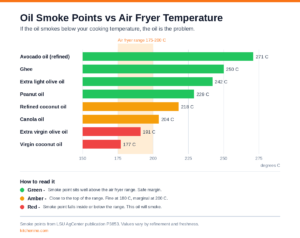
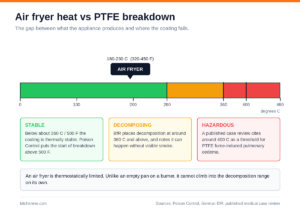
Many air fryer baskets use a PTFE-based non-stick coating. PTFE is stable at normal cooking temperatures and begins to break down only when substantially overheated. Poison Control notes that the coating starts to break down above roughly 500 °F (260 °C), and the BfR places meaningful decomposition at around 360 °C. Published clinical literature indicates that symptoms in humans are generally associated with considerably higher temperatures still, with a case review pointing to approximately 400 °C as a threshold for serious effects.
Consumer air fryers commonly top out at 400 °F, with some models reaching 450 °F — roughly 205 to 230 °C. That sits below the point at which PTFE is understood to begin degrading.
Two qualifications matter, and they are the reason we are not telling you it is simply fine.
First, Poison Control notes that scratches in a non-stick surface can lead to fumes being released. That is the second reason the abrasive-cleaning prohibition in your manual is not just about appearance.
Second, the BfR observes that when PTFE does decompose, hazardous substances enter the air without visible smoke formation.
You cannot rely on seeing a problem.
The practical conclusion: a warm plastic odour from a new unit operating within its normal temperature range is not evidence of coating breakdown. A basket with a scratched, flaking, or peeling coating should be replaced regardless of how it smells.
What this guide cannot tell you
We do not know which materials your specific model uses, and manufacturers rarely publish a full material breakdown. We cannot tell you how many cooking cycles your unit will take to stop smelling, because that depends on the model and how it was stored and shipped. We were unable to verify the widely circulated vinegar-bowl and lemon-slice deodorising methods against any manufacturer manual, so we are not recommending them.
If the smell persists after several cycles and a thorough clean, and it is affecting the taste of your food, contacting the retailer or manufacturer within the return window is a reasonable step. Our How We Research page explains where this method is strong and where it is weak.
Frequently asked questions
How long should a new air fryer smell like plastic?
The odour should be clearly weaker with each use and largely gone within the first several cooking cycles. There is no fixed number that applies across models. The pattern matters more than the count: fading is normal, constant is not.
Is the food cooked during the smell safe to eat?
Manufacturers do not generally advise discarding food cooked during first use, but food readily absorbs odours, and anything cooked while the smell is strong is likely to taste of it. Running the first cycles empty of food you intend to eat is a practical choice rather than a safety requirement.
Does a stainless steel or ceramic-coated air fryer avoid the problem?
Not entirely. The smell comes from several sources, including packaging residue and heat-resistant plastics in the housing and controls, not only the basket coating. A different basket material changes one contributor, not all of them.
My air fryer smelled fine for a year and now smells like burning. What changed?
Accumulated grease on the heating element is the most common explanation, and it is fixed by cleaning. If a thorough clean does not resolve it, or the smell is electrical rather than food-related, treat it as a fault and stop using the unit.
Can I use the air fryer while it still has a mild smell?
If the unit is new, the smell is mild and fading, and there are no signs from the stop-immediately list above, continued use with good ventilation is consistent with manufacturer guidance. If any item on that list applies, no.