Basket vs Oven-Style Air Fryers: Which Should You Buy?
Ask which style of air fryer is better and you will get a confident answer either way. Basket owners say the oven-style models never get anything properly crisp. Oven-style owners say the basket is too small to cook a meal in. Both groups are describing the same machine from opposite ends, and both are right.
The reason is structural. Every air fryer is a small convection oven with an aggressive fan. Crispness comes from a tight chamber that keeps hot air moving fast across the food. Capacity comes from a large chamber. Those two things are in direct opposition, and no manufacturer has repealed the physics. When you choose between a basket model and an oven-style model, you are not choosing between a good design and a bad one. You are choosing which compromise you would rather live with.
The short answer
Buy a basket model if crisp texture is the reason you want the appliance at all, if you cook for one to three people, or if counter space is tight. Buy an oven-style model if you want one machine to replace a toaster oven as well, if you regularly cook for four or more, or if you want to see the food while it cooks.
If you cannot decide, apply this test. Picture the last five things you cooked or reheated on your counter. If most of them were chips, wings, nuggets or anything else where the whole point is the outside surface, buy the basket. If most of them were pizza slices, toast, tray bakes or reheated leftovers spread flat, buy the oven.
What actually separates the two
America’s Test Kitchen splits the category into two shapes: pod-shaped air fryers and air-fryer toaster ovens. The pod-shaped ones are what most people picture, with a drawer that pulls out. The oven-style ones look like a small countertop oven with a glass door, and they cook on racks or in a mesh basket that slides in.
Consumer Reports describes the mechanism the same way for both. Air frying is a type of convection cooking, but the fan runs at a higher speed, directing a hot airstream onto the food.
On an oven-style machine you are meant to use a mesh basket instead of a pan, so that the air can circulate all around the food—top, bottom, and sides.
Use a solid tray and you have quietly turned your air fryer back into a small convection oven.
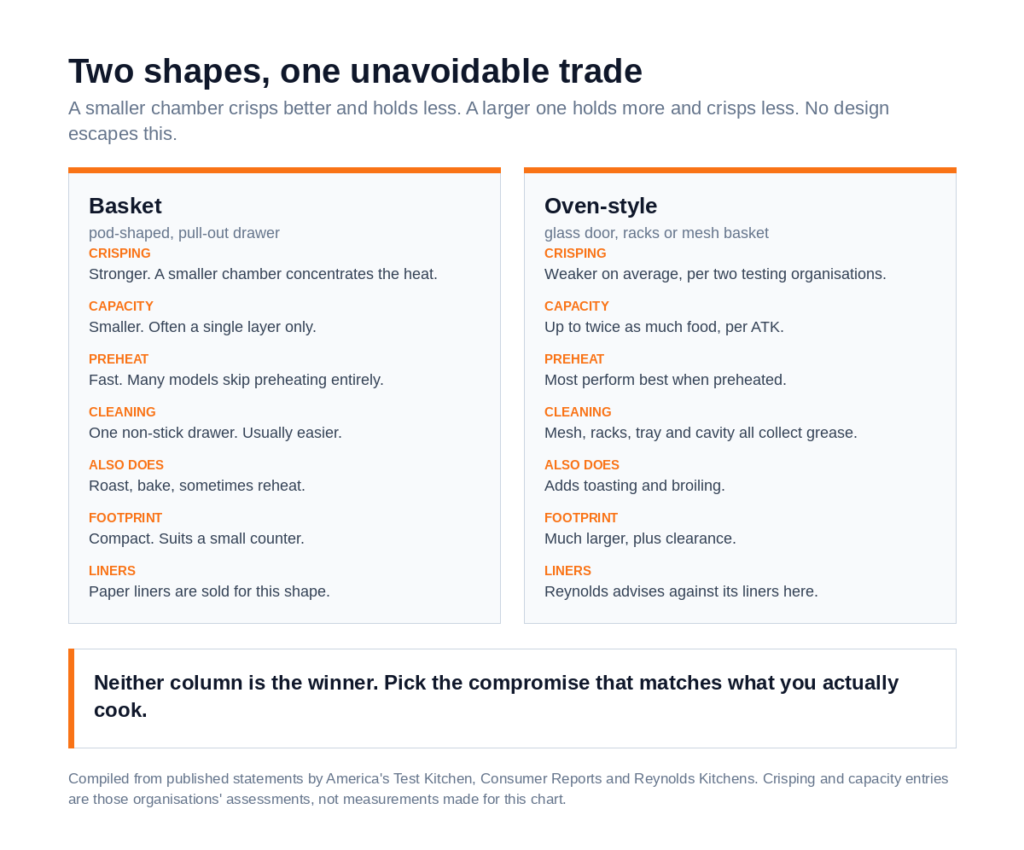
Here is where the two designs land on the things people actually notice.
| What you notice | Basket (pod-shaped) | Oven-style |
|---|---|---|
| Crisping | Stronger — smaller chamber, more concentrated heat | Weaker on average, per two testing organisations |
| Capacity | Smaller; often one layer only | Larger; up to twice as much food, per ATK |
| Preheating | Fast; many models skip it entirely | Most perform best preheated |
| Cleaning | Non-stick drawer, usually easier | Mesh baskets and racks hold grease more readily |
| Other jobs | Air fry, roast, bake, sometimes reheat | Adds toasting and broiling |
| Counter footprint | Smaller | Much larger |
| Visibility while cooking | None — you must pull the drawer | Through the door |
| Liner compatibility | Paper liners sold for this shape | Maker of the best-known liners advises against it |
Crisping: what the testers actually say, and how it gets exaggerated
This is the part worth reading slowly, because the internet states it far more strongly than the sources do.
Consumer Reports puts it carefully: But our evaluations suggest that you’ll probably get crisper results from a dedicated air fryer.
Note the hedging. Suggest. Probably. In its separate air fryer buying guide it says the same thing again in general terms: Generally, air-frying toaster ovens often can’t achieve the same level of crispiness as true air fryers.
Generally. Often. These are not the words of an organisation reporting a wide, clean gap.
The explanation it gives is the one that matters, because it tells you the gap is caused by size rather than quality: The difference lies in the dedicated air fryer’s smaller size compared with that of a toaster oven.
Food in the smaller chamber gets a more concentrated blast of heat, allowing it to crisp better and faster.
There is also a widely repeated figure that a dedicated air fryer cooks about 40 percent faster. That number does come from Consumer Reports, but read how it is attributed: up to about 40 percent quicker, depending on the food, according to a staffer who has cooked with both
. That is a colleague’s kitchen experience, offered as such. It is not presented as a lab result, and this guide will not launder it into one.
What survives all the hedging is a modest, useful claim: on average, the basket shape crisps better, because it is smaller. If crisping is the whole reason you are buying, that is enough to decide. If it is one reason among several, it is thinner evidence than the confident blog headlines suggest.
Capacity: the oven-style advantage is real and large
Where the oven-style machines win, they win clearly. ATK says air-fryer toaster ovens can hold more food than most air fryers—up to twice as much.
Consumer Reports notes that its featured air fryer toaster ovens all have larger capacities than even the largest dedicated air fryer in its ratings, and that toaster ovens are typically large enough to make 12-inch pizzas or multiple dishes simultaneously, whereas dedicated air fryers tend to be smaller.
The limitation on the basket side is not subtle either. Consumer Reports’ verdict on dedicated air fryers as a class: Most aren’t big enough to cook for a crowd unless you cook in batches.
And capacity is not simply a number on the box. The usable amount is set by how much food fits in a single layer, because overcrowding stops the airflow that makes the appliance work at all. The USDA’s food safety guidance is blunt about the consequence: Overcrowding the appliance can prevent enough air circulation to properly cook the food.
That is a safety warning, not a texture note. We covered how to translate advertised litres into real portions in our guide to what size air fryer you actually need, and the same logic applies to both shapes here.
So the honest framing of the capacity trade is this: an oven-style machine gives you more floor area, and floor area is the thing that actually limits how much food you can cook properly. That is a stronger argument for oven-style than most crisping comparisons are against it.
Speed, preheating and the batch problem
ATK’s summary of the basket models is that Because they’re smaller, they accommodate less food than air-fryer toaster ovens but also take less time to heat—most don’t even require preheating.
Oven-style machines, by contrast, most perform best when preheated.
For a single portion, that preheat is the whole difference. A basket model is ready when you press start. For a full meal, the maths inverts: one preheat followed by one large batch beats no preheat followed by three small ones.
Which? found the same inversion when it compared an air fryer against a built-in oven on energy. Its science team leader, Steph Kipling, summarised it: The air fryer often used less than half the energy, and the results were just as tasty. However, the savings soon drop off if you have to cook in batches, so an oven may still be the most economical choice when cooking for a crowd.
One caution about that study, because it is easy to misapply. It compared a small basket air fryer with a full built-in oven. It did not compare a basket air fryer with an oven-style air fryer, and neither did any source available for this guide. So the batch principle carries over, but the specific figures do not. Anyone who quotes those pence-per-meal numbers as a basket-versus-oven-style result is stretching them past what the test did.
Cleaning: the reversal most buying guides skip
Cleaning is where the oven-style advantage goes into reverse, and it is a daily cost rather than an occasional one.
ATK is specific about why: air-fryer toaster ovens can be a bit trickier to clean—the metal baskets you use for air frying collect grease and batter more readily than the air fryers’ nonstick drawers.
A basket model gives you one sealed non-stick drawer. An oven-style machine gives you a mesh basket, a drip tray, racks, an interior cavity and a glass door, all of which collect spatter.
That matters more than it sounds, because grease left inside either shape becomes the source of the two most common complaints about these appliances. If you want the detail, see our guides on why an air fryer smokes and how to clean the heating element. The short version is that the more separate surfaces a machine has, the more places old fat can sit and burn.
There is a second-order effect on the non-stick coating too. More parts to scrub means more scrubbing, and abrasive cleaning is what shortens coating life. We looked at what the coating is and when it becomes a problem in our guide to air fryer non-stick safety, and at the visible signs of wear in when to replace an air fryer basket.
The accessory trap nobody mentions before you buy
This one rarely appears in comparisons, and it should, because it quietly narrows what you can buy afterwards.
Reynolds Kitchens, which makes the best-known air fryer parchment liners, states that its liners are not recommended for use in rectangular or toaster oven-style air fryers.
The liner category that exists specifically to make cleanup easier is designed around the round basket shape.
So the machine that is harder to clean is also the machine with fewer sanctioned shortcuts for cleaning it. That is not a reason on its own to reject oven-style, but it belongs in the decision, and it is worth reading the full picture on liners before relying on them either way — see the safety rules for parchment and silicone liners. The same shape-dependence applies to foil, which we covered in can you put aluminium foil in an air fryer.
Cost and counter space
ATK notes that air fryers are comparatively compact and inexpensive
, while air-fryer toaster ovens have a much larger footprint, so they are best for home cooks with plenty of counter space.
Most cost considerably more than the average basket model.
Consumer Reports adds the argument on the other side, which is the strongest financial case for oven-style: buying one good combined unit can save you more than $100 compared to purchasing a top-rated conventional toaster oven and air fryer separately.
If you were going to own both appliances anyway, the combined machine is the cheaper and smaller answer. If you were only ever going to own one, that argument does not apply to you.
Measure your counter before you decide anything else. An oven-style unit needs clearance above and behind it as well as the space it stands on, and a machine that lives in a cupboard because it does not fit gets used roughly never.
Matching the machine to the household
| Your situation | Better fit | Why |
|---|---|---|
| Cooking for one or two, mostly crisp food | Basket | No preheat, best crisping, smallest footprint |
| Cooking for four or more in one go | Oven-style | Up to twice the food; batching erases the basket’s speed |
| You still own and use a toaster oven | Oven-style | Replaces two appliances with one, per Consumer Reports |
| Small kitchen, limited counter | Basket | Oven-style needs the footprint plus clearance |
| You hate cleaning | Basket | One non-stick drawer instead of racks, mesh and a cavity |
| You reheat flat food — pizza, tray bakes | Oven-style | Floor area and visibility through the door |
| Trying air frying for the first time | Basket | Cheapest way to find out if you will use it |
Consumer Reports arrives at much the same split from the other direction. An air fryer toaster oven suits you if you don’t insist on very crispy foods and are mainly looking for a fast way to cook vegetables, flatbreads, and meat with a bit of surface texture.
But if fries, leftover nachos grandes, and fried chicken wings are frequently on the menu, then a dedicated air fryer will give you maximum crackle and crunch.
What this guide cannot tell you
- How big the crisping gap is in numbers. Both organisations say the basket shape crisps better on average. Neither published a figure this guide could read and verify, and the one measurement-style comparison found was behind a paywall.
- Whether a specific oven-style model beats a specific basket model. Both sources describe averages across a category. A strong oven-style machine can plainly out-crisp a weak basket one.
- Energy cost of one style against the other. The available testing compares an air fryer with a full built-in oven. Nobody found comparing the two air fryer shapes on energy.
- Which lasts longer. No durability comparison between the two form factors was located.
- Whether a basket model can replace your oven. Which? found it can for single portions and cannot for a crowd, and that finding concerns basket models specifically.
Frequently asked questions
Is an air fryer toaster oven a real air fryer?
Mechanically, yes. Consumer Reports describes both as convection cooking with a fast fan directing hot air onto the food. The difference is chamber size and the resulting concentration of heat, not the presence or absence of a real air-frying mechanism.
Does a toaster oven with an air fry button count?
It counts only if you use the mesh basket that came with it. Consumer Reports is explicit that the food goes in the mesh basket rather than a pan so air can reach every surface. On a solid tray, the underside of the food will not crisp.
Should I use convection mode or air fry mode?
Consumer Reports separates them by job. Convection uses top and bottom elements with a rear fan for even temperature, which suits baking across multiple racks and roasting. Air fry runs the fan faster and aims the airstream at the food, which suits anything where you want a crisp surface.
Can I use liners in an oven-style air fryer?
The largest maker of air fryer parchment liners says its product is not recommended for rectangular or toaster oven-style machines. Check what your own manufacturer permits rather than assuming a liner sold for air fryers fits every air fryer.
If I can only own one, which is safer to buy?
Neither shape is safer as a category. The failure modes are the same for both — grease build-up, overcrowding, blocked airflow — and they are governed by how the machine is cleaned and loaded rather than which shape it is.
Related reading
- What size air fryer do you actually need?
- Parchment paper and silicone liners: the safety rules
- How to clean an air fryer heating element
- Why is my air fryer smoking?
- When should you replace an air fryer basket?
- Why does my air fryer smell like plastic?
Sources: America’s Test Kitchen, “Should You Get an Air Fryer or an Air-Fryer Toaster Oven?” (published 11 May 2023); Consumer Reports, “Best Air Fryer Toaster Ovens” (updated 1 January 2026); Consumer Reports air fryer buying guide (updated 20 November 2025); Which?, “Air fryer vs oven: energy usage, costs and cooking results compared” (19 June 2026); USDA Food Safety and Inspection Service, “Air Fryers and Food Safety” (last updated 24 June 2024). Liner guidance is from Reynolds Kitchens’ published instructions, cited in full in our liner safety guide. Our sourcing standards are set out in how we research.