Can You Put Glass in an Air Fryer? The Two Rules That Decide
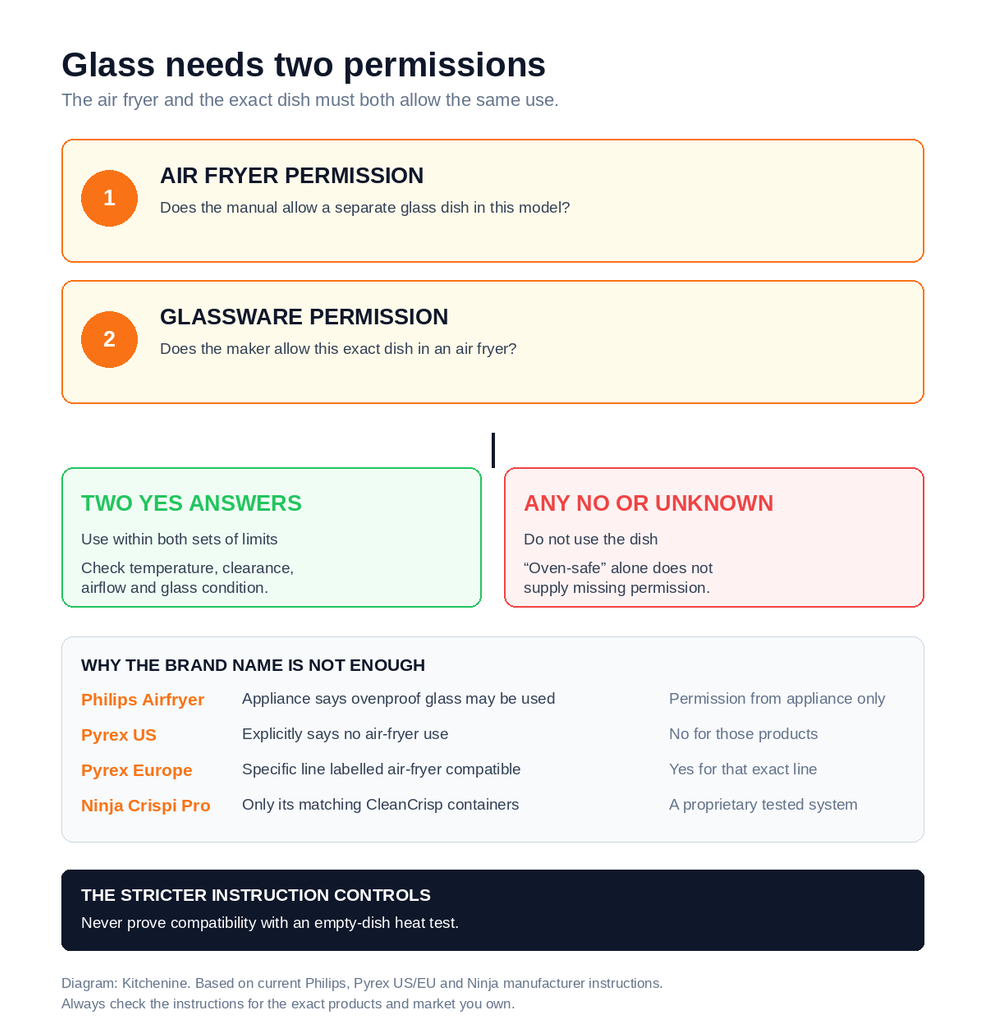
You can put glass in an air fryer only when both the air fryer manufacturer and the manufacturer of that exact glass dish permit it. If either set of instructions says no—or you cannot identify the dish—do not use it.
That answer is stricter than the common advice to use “any oven-safe glass.” It has to be, because the manufacturers themselves disagree. Philips says ovenproof glass dishes can be used in many of its Airfryer models. Pyrex in the United States says its glassware cannot be used in an air fryer. Pyrex Europe, meanwhile, sells a different borosilicate dish specifically labelled air-fryer compatible.
The brand name does not resolve the question. The exact product, market and instructions do.
The two-permission rule
Before putting any glass dish into an air fryer, answer both questions:
- Does the air fryer’s manual allow a separate glass dish?
- Does the glassware maker allow that exact dish in an air fryer?
You need two yeses. One yes and one no means no.
| Air fryer says | Glassware says | Decision |
|---|---|---|
| Yes | Yes, specifically for air fryers | Use within both sets of limits |
| Yes | No | Do not use it |
| No or only approved accessories | Yes | Do not use it |
| Unknown | “Oven-safe” only | Not enough information |
| Unknown dish or no markings | Unknown | Do not test it in the appliance |
Why “oven-safe” does not settle it
Air fryers use forced convection, but their heating layout can place a dish much closer to the element than a full-size oven does. The chamber is small, airflow is concentrated and preheating behaviour differs by model. Our comparison of air fryers and convection ovens explains why the shared cooking method does not make every use interchangeable.
Pyrex US draws the boundary explicitly. Its FAQ says its glass bakeware is suitable for a completely preheated conventional or convection oven. The same FAQ separately says:
NO – Pyrex glass cannot be used in an Air Fryer as this is a direct heat source.
It also prohibits its glassware in toaster ovens and under broilers. Therefore, “safe in a convection oven” cannot be converted into “safe in every appliance that uses convection.”
Anchor Hocking makes the same distinction without naming air fryers on its care page. Its bakeware can be used in properly sized preheated conventional or convection ovens up to 425 °F, but not in toaster ovens, under broilers or near other direct heat sources. That is not permission for an air fryer. If a use is absent from the instructions, contact the manufacturer rather than filling the gap with a rule from another brand.
The contradiction is real, not a mistake
Philips Australia states: You can use any ovenproof dish or mould in the Philips Airfryer, whether it is made of glass, ceramic, metal or silicone.
It then lists the models covered and provides maximum dimensions.
That grants permission from the appliance side. It does not rewrite the glassware’s instructions. A Philips owner in the United States with a Pyrex US dish still has one yes and one no, so the answer remains no.
Pyrex Europe demonstrates the other possibility. It sells a purpose-built, borosilicate dish labelled Suitable for air fryer
, with air fryer use named in the instructions. That exact product supplies the second yes—provided the air fryer manual also accepts a separate dish and the dimensions leave enough clearance.
The regional difference matters. “Pyrex” is not one universal specification. The US FAQ says no to air fryers; the European product page says yes for a particular line. Do not use a European product claim to authorise a different dish bought in another market.
A glass air fryer does not prove ordinary glass is safe
Some appliances are designed around proprietary glass containers. Ninja’s Crispi Pro uses its own borosilicate CleanCrisp containers and says they are resistant to thermal shock. Yet the same FAQ says those containers are not oven, stovetop or broiler safe and that only Ninja CleanCrisp containers are compatible with the machine.
This is the reverse of the usual assumption: a container can be approved for its matching glass air fryer while not being approved for an ordinary oven. Intended use is more informative than the material name.
Do not put a random bowl into a glass-container air fryer because it appears to be the same size. The appliance and container can be a tested system with fixed handles, supports, clearances and sensors that ordinary cookware does not reproduce.
The failure mode: thermal shock and damaged glass
Glass expands as it heats and contracts as it cools. If one part changes temperature much faster than another, stress develops across the dish. Enough stress can cause cracking or sudden fragmentation. Chips, deep scratches and previous impacts create weak points where failure can begin.
Manufacturer instructions converge on the same precautions:
- Do not add cold liquid to hot glass.
- Do not place hot glass on a wet or cold surface.
- Let hot glass cool before putting it in water, a sink or dishwasher.
- Do not use a dish that is chipped, cracked or deeply scratched.
- Avoid hard impacts and abrasive tools that can weaken the surface.
These warnings are not theoretical. A 2010 Consumer Reports investigation examined 163 reported glass-bakeware incidents and found at least 42 reports of injuries. Its severe thermal tests found that the US soda-lime dishes it tested shattered at lower temperature differentials than the European borosilicate pans. The investigation is old and concerned bakeware rather than air fryers, so it does not quantify today’s risk in an air fryer. It does establish that thermal-shock breakage and sharp flying fragments are documented failure modes, not internet folklore.
Do not decide by glass type alone
Borosilicate glass generally changes dimensions less with temperature than ordinary soda-lime glass, which can improve resistance to thermal shock. Tempering can also change impact and breakage behaviour. But those broad material properties do not tell you whether a particular dish was designed, processed, inspected or warranted for a particular appliance.
Pyrex US says both its soda-lime and borosilicate products share its use-and-care instructions. Its US air-fryer answer is still no. Pyrex Europe’s air-fryer-specific product is borosilicate and explicitly approved. The useful distinction is not “borosilicate good, soda-lime bad.” It is “documented use permitted or not permitted.”
Fit and airflow are separate safety checks
A permitted dish can still be the wrong size. Philips instructs users to leave space around the baking dish so air can pass and to place the dish in the basket rather than directly in the pan. Putting it in the pan eliminates lower airflow, so only the top of the food heats effectively.
Check all three dimensions, not only diameter:
- Width and length: the dish must not touch the basket walls.
- Height: the rim and food must remain clear of the heating element.
- Air path: space must remain around the dish, and the manufacturer’s required basket or support must stay in place.
A glass dish also blocks airflow beneath food. That may be desirable for cake, gratin or food in sauce, but it gives up the all-around circulation that makes an air fryer crisp well. If the goal is fries or wings, a solid dish defeats part of the appliance’s advantage.
A safe decision checklist
- Identify the air fryer model. Read its manual or official support page, not a generic article.
- Identify the exact dish. Find its model number, packaging or current manufacturer instructions.
- Look specifically for “air fryer.” “Oven-safe,” “microwave-safe” or “heat-resistant” does not override an air-fryer exclusion.
- Use the lower limit. If the appliance reaches 450 °F and the dish is limited to 425 °F, the dish’s 425 °F limit controls.
- Inspect the glass in bright light. Retire it if chipped, cracked or deeply scratched.
- Measure clearance. Keep the dish away from walls and the heating element and preserve the required airflow.
- Avoid temperature shock. Follow the glassware maker’s rules for starting temperature, liquids, cooling and surfaces.
- Use dry oven mitts. Glass and the basket become hot even when handles look cool.
What not to do
- Do not perform an empty-dish “test run.” Surviving once does not prove the dish is approved or free of damage, and a failure can contaminate the appliance with fragments.
- Do not use drinking glasses, jars or food-storage containers without cooking instructions. Microwave-safe does not mean air-fryer-safe.
- Do not move a dish directly from freezer to a hot air fryer unless the exact product instructions explicitly permit that transition.
- Do not add water to hot glass. Let the dish cool according to its instructions.
- Do not assume every product from one brand shares the same permission.
If the glass cracks in the air fryer
- Stop the cooking cycle and unplug the appliance if it is safe to reach the plug.
- Do not pour in water and do not handle hot fragments.
- Let the appliance cool completely.
- Wear closed shoes, eye protection and thick gloves during cleanup.
- Discard the food. Tiny transparent fragments are difficult to verify and remove.
- Follow the air fryer manufacturer’s cleaning instructions and inspect the basket, pan and element area before using it again.
- Contact the glassware and appliance manufacturers if damage extends beyond the dish.
What this article cannot tell you
- Whether an unmarked dish is borosilicate, tempered soda-lime or ordinary glass.
- Whether microscopic damage has weakened a dish that still looks normal.
- Whether instructions from one country apply to a similarly branded product sold in another.
- The probability that a permitted glass dish will break. The sources provide warnings and use limits, not an air-fryer failure rate.
- Whether a third-party dish fits your model without measurements.
Frequently asked questions
Can Pyrex go in an air fryer?
Not as a brand-wide rule. Pyrex US explicitly says its glass cannot be used in an air fryer. Pyrex Europe sells a separate borosilicate line specifically approved for air fryers. Follow the instructions for the exact item you own.
Can an oven-safe glass bowl go in an air fryer?
Only if the air fryer instructions permit a glass dish and the bowl’s own instructions permit air-fryer use. Oven-safe alone is not enough when the manufacturer excludes air fryers or toaster ovens.
Is borosilicate glass always safe in an air fryer?
No. Borosilicate generally resists thermal changes better than ordinary glass, but material alone does not establish intended use, condition, dimensions or clearance.
Can glass touch the bottom of the air fryer pan?
Not in the Philips models covered by its support page. Philips says to place the dish in the basket, never directly in the pan, because doing so removes airflow beneath it. Follow your own model’s instructions.
What is safer than an unidentified glass dish?
Use the basket and accessories supplied with the appliance. If a separate container is necessary, buy one explicitly listed by the air fryer manufacturer for that model. Our guide to air fryer accessories worth buying explains why model fit matters more than “universal” marketing.
The answer in one sentence
Use glass only when your exact air fryer and your exact dish both explicitly allow it; otherwise choose an approved accessory instead of conducting a heat test at home.
Sources: Philips Airfryer support, including covered models, dish placement and dimensions; Pyrex US FAQ, including its explicit air-fryer prohibition and thermal-shock precautions; Pyrex Europe air-fryer-compatible dish instructions; Anchor Hocking care and use; Ninja Crispi Pro FAQ (30 March 2026); and Consumer Reports’ 2010 glass-bakeware investigation. The Consumer Reports evidence is historical and concerns bakeware, not an air-fryer failure-rate study.