Parchment Paper and Silicone Air Fryer Liners: The Safety Rules
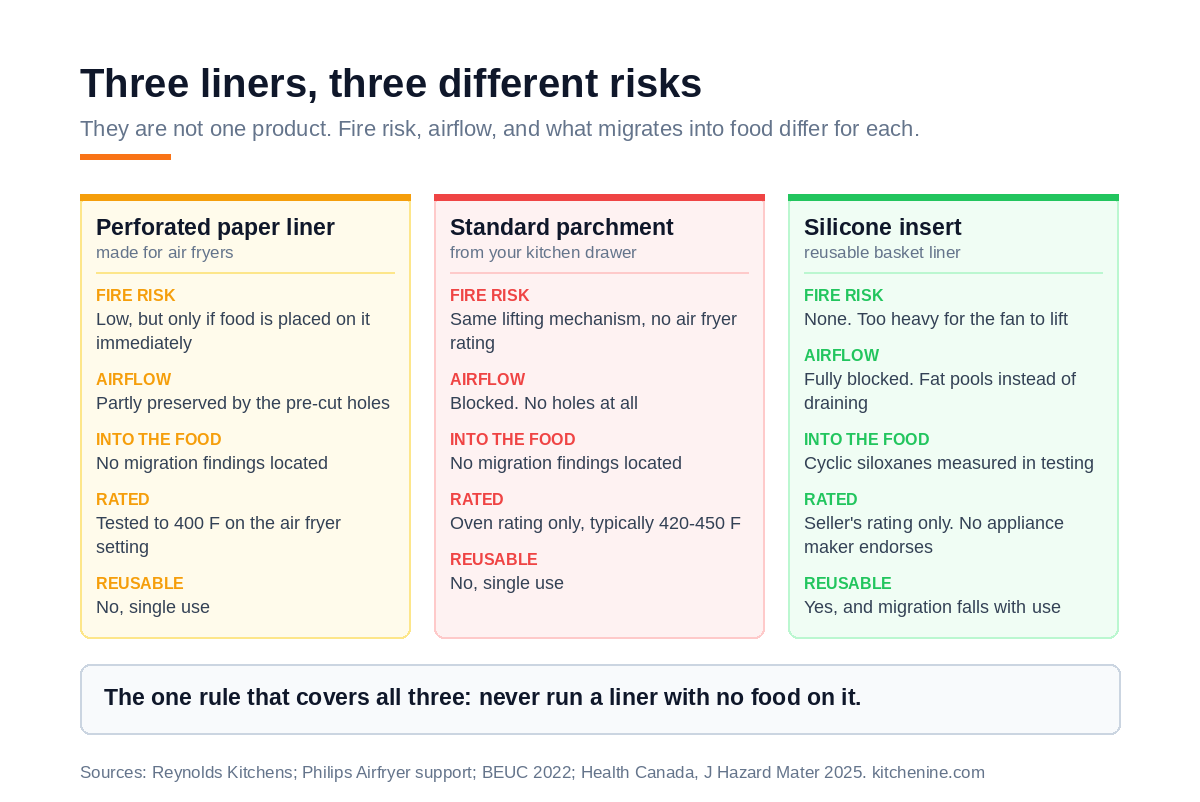
Short answer: a liner made and tested for air fryers is a different product from the parchment paper in your kitchen drawer, and the largest parchment manufacturer in the United States says so itself. Purpose-made perforated liners are rated to a specific temperature and designed to let air through. Standard parchment is not. Silicone liners are reusable and will not blow around, but they are not chemically inert, and the testing that exists says the newest liner is the one that transfers the most into your food.
Almost every guide to this question treats “liners” as one category. They are three products with three different risk profiles. This guide separates them, and it separates the two questions that get mixed together: will it catch fire, and will it end up in the food.
What the manufacturers actually say
This is the part worth reading twice, because two of these statements come from companies with a commercial interest in selling you the product they are describing.
| Liner type | What the source says | Who says it |
|---|---|---|
| Purpose-made perforated paper liner | designed and tested for air fryer use at temperatures up to 400°F | Reynolds Kitchens |
| Standard parchment paper | We advise against using standard parchment paper in the air fryer. | Reynolds Kitchens |
| Any paper, in a Philips machine | No, using baking paper and tin foil in your Philips Airfryer is not recommended | Philips |
| Silicone liner | No appliance manufacturer statement located | — |
Note the last row. Silicone liners are sold everywhere, usually with a temperature rating printed by the liner seller, but we could not find a single air fryer manufacturer that endorses them by name. That absence is not proof of a hazard. It does mean nobody with engineering knowledge of your machine has put their name to it.
Reynolds also draws a boundary in the other direction. Their air fryer liners are not recommended for use in rectangular or toaster oven-style air fryers
, and the same page says of using them in a conventional oven: No. They are intended solely for use in an air fryer.
A liner rated for one appliance is not rated for all of them.
The fan is the entire difference
People reasonably assume paper in a hot appliance is a burning risk. The evidence says the temperature is not really the problem.
America’s Test Kitchen looked at exactly this for ovens. Most parchment, they note, is rated for use at temperatures no higher than 420 to 450 degrees
, yet they recommend it for bread and pizza baked as high as 500 °F. Their conclusion after contacting manufacturers: Using parchment at higher-than-recommended temperatures does not release noxious chemicals, and the paper will not burn.
What does happen is that it can darken and turn brittle
, and for anything over 30 minutes it can break down enough to fall apart
.
That finding is published for ovens, and an oven is a still box of hot air. An air fryer is a small box with a fan running at full speed a few centimetres from a glowing element. Philips describes the consequence plainly: if you put paper in without placing food on it, the baking paper or tin foil could be sucked into the heating element and start to burn.
So the mechanism is not combustion at cooking temperature. It is a light sheet being lifted by moving air onto the one surface in the machine that is far hotter than the set temperature. Reynolds gives the same instruction from the opposite direction: Never allow the liner to directly contact a heating element of any air fryer.
This is why the single most important rule is about when you insert the liner, not whether you use one. It is the same reasoning that governs aluminium foil in an air fryer, and it is a common thread in air fryers that suddenly start smoking.
If you use a paper liner, these are the rules
Every item below is taken from the Reynolds instructions for their own tested product, not from general advice.
- Preheat with the basket empty.
Always preheat the air fryer BEFORE placing the liner and food inside.
The preheat is the danger window, because there is nothing holding the paper down. - Put the liner in, then put the food on immediately.
Always place the paper liner flat in your basket and then immediately place food on top of the liner.
- Never run the liner empty. The food is the weight that keeps it in place. A liner alone in a running machine is the failure case both Philips and Reynolds describe.
- Stay at or below the rated temperature. For the Reynolds product that is 400 °F, and the instruction is to avoid
temperatures exceeding 400°F
. Check the number on your own box. - Use the perforated kind. The holes are functional, not decorative: they
allow hot air to circulate freely around the food
. - Do not overcrowd. Arrange food in a single layer so air can actually reach the holes.
- Do not substitute the parchment from your drawer. It is unperforated, it is not rated for this appliance, and its own manufacturer advises against it.
One more, which is ours rather than theirs: never use wax paper. Wax paper and parchment look similar and are not the same product. Parchment is silicone-coated; wax paper is wax-coated and is not made for direct oven heat.
Silicone liners: reusable, but not inert
Silicone solves the fire question outright. It is heavy enough that the fan will not lift it, and it does not combust at air fryer temperatures. Marketing copy tends to stop there and call it non-toxic.
The independent testing is less comfortable. In 2022, nine European consumer organisations tested 44 silicone baking moulds through a study coordinated by BEUC. Ten of them, 23%, either released contaminants in high amounts – or the amount increased between tests, indicating that the products are not suitable for repeated use.
Two exceeded the legal limit set in the EU Plastics Regulation. In 36 products, 82% of the sample, the lab detected substances of concern, including some the EU has identified as Substances of Very High Concern or that are suspected endocrine disruptors
.
BEUC is careful about what that means, and so are we: those substances were found at low levels, suggesting the absence of an immediate concern for consumer health
, and none of the tested products in isolation may endanger human health
. Sixteen per cent of the moulds released only minor amounts and no substances of concern, which tells you the variation is between products, not inherent to the material.
The regulatory gap is the part most consumers do not know. BEUC’s finding is that Unlike plastic materials, no dedicated EU rules exists to ensure that silicone products meant for food contact are safe for consumers.
Director General Monique Goyens put it more bluntly: EU legislation meant to protect consumers is half baked as it essentially only regulates plastic materials.
What gets released, and how much
A 2025 study by researchers at Health Canada, published in the Journal of Hazardous Materials, measured this directly on 25 silicone bakeware products bought on the Canadian market. It baked them at 177 °C for 60 minutes — squarely inside the range an air fryer works in.
| Measurement | Result |
|---|---|
| Cyclic siloxanes (D4–D16) in the products themselves | 680 to 4,300 µg/g across 25 products |
| Average siloxanes in the baked food simulant | 105 µg/g |
| Siloxanes in indoor air, one-hour average while baking | up to 646 µg/m³, declining rapidly afterwards |
| What increased migration | bakeware type, surface area, and fat content |
| Highest exposure per body weight | young children, by both eating and breathing |
Two things in that table matter for air fryer use specifically. Migration rose with fat content, and an air fryer basket is where fat renders out of chicken skin and bacon. And the exposure was not only through food: siloxanes were emitted in the air when baking
, which is a route no product label mentions.
The finding that changes how you should use one
The most actionable result in the Health Canada study is easy to miss: Repeated baking shows a steady decline in migration and emissions, suggesting depletion of siloxanes in the products over time.
Read that in reverse. A brand-new silicone liner is the worst one it will ever be. This is the opposite of how people treat kitchen equipment, where new usually means safest, and it inverts the usual advice about when to replace worn air fryer parts. With silicone, the first few uses carry the highest transfer, and it falls from there.
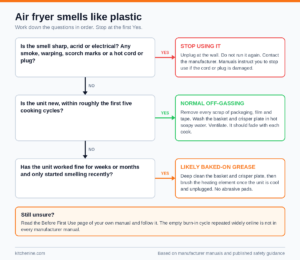
The practical response is to run a new silicone liner empty, at your machine’s normal cooking temperature, for a cycle or two before you cook food on it, and wash it before first use. The BEUC finding that some products got worse between tests is the important caveat: if a liner starts smelling or feels tacky, that is a reason to bin it rather than season it. If a persistent smell is your actual complaint, our guide to air fryers that smell like plastic covers the other causes.
The cost nobody puts on the box: airflow
Set chemistry and fire aside. A liner changes how the appliance works.
An air fryer is a convection oven that works by pushing hot air through a perforated basket, including from underneath. Philips lists reduced airflow as its first objection to lining the basket, ahead of the fire risk: covering the bottom means the airflow inside the airfryer is reduced. This results in a diminished cooking performance of your Philips Airfryer.
A perforated paper liner is a compromise with that problem — the holes exist precisely to preserve some circulation. A solid silicone liner is not. A silicone basket insert seals the floor of the basket completely, so nothing flows up through it and rendered fat pools rather than draining. You get easier cleanup and less crisp food, and grease sitting in the basket rather than draining is exactly the condition that leads to baked-on residue on the heating element.
There is a reasonable trade here. For sticky, saucy, or cheesy food where crispness is not the point, a liner saves real scrubbing and protects the coating from scraping. For chips, wings, and anything you want crisp underneath, a liner is working against the machine you paid for.
What this guide cannot tell you
- Whether your specific liner is one of the good ones. BEUC tested 44 moulds and found a 23% problem rate. They did not publish a pass list that maps onto products sold today, and none of the tested items were air fryer liners specifically.
- Whether silicone liners behave like silicone bakeware. Both studies here tested baking moulds in ovens. The chemistry should carry over, but nobody has published air fryer-specific migration data, and an air fryer moves far more air across the surface.
- What the safe number is. The Health Canada study measured exposure; it did not set a tolerable intake for cyclic siloxanes from this route. A measurement is not a limit.
- Whether your appliance brand permits liners. Philips says no to paper. We found no air fryer manufacturer that addresses silicone inserts at all. Your manual is the authority, and its silence is not consent.
- Whether “food-grade”, LFGB, or FDA-compliant labelling predicts real-world release. We did not find independent testing that ties those claims to measured migration in finished consumer liners.
Frequently asked questions
Can I just cut holes in normal parchment paper?
It solves the airflow problem, not the ratings problem. Reynolds advises against standard parchment in an air fryer even though they manufacture both products, and standard parchment carries an oven rating rather than an air fryer one. Perforating it does not change what it was tested for.
My liner flew up and touched the element. Is the food ruined?
If paper contacted the element and scorched, discard the liner and the food, and check the element for stuck residue before the next cook. The bigger issue is that it happened at all: it means the liner went in without food on top, or the machine was preheating. Fix the sequence rather than the symptom.
Are silicone liners safer than the non-stick coating already in my basket?
They are different materials with different evidence bases, and no source we found compares them directly. Silicone avoids the PTFE question entirely, but carries the siloxane findings above. We cover the coating side separately in our guide to air fryer non-stick safety.
Does a liner protect the basket coating?
Reynolds says liners protect the basket from scratches and wear
. That is plausible and is a genuine benefit, though it is the manufacturer’s own claim rather than an independent finding.
Do I need a liner at all?
Reynolds themselves say no: Liners aren’t necessary, as most modern air fryers have non-stick coatings.
They are a cleanup convenience, and for greasy or cheesy food a meaningful one. Nothing about air frying requires them.
Related reading
- Can You Put Aluminum Foil in an Air Fryer?
- Is Air Fryer Non-Stick Coating Safe?
- Why Is My Air Fryer Smoking?
- How to Clean an Air Fryer Heating Element
Sources for this article: Reynolds Kitchens air fryer liner guidance (updated 30 May 2025); Philips Airfryer support documentation; America’s Test Kitchen on parchment at high temperatures; BEUC and nine national consumer organisations, silicone bakeware test, 6 December 2022; Health Canada researchers, “Silicone bakeware as a source of human exposure to cyclic siloxanes”, Journal of Hazardous Materials, 2025. We do not test products in our own kitchen — read how we research.