What Size Air Fryer Do You Actually Need
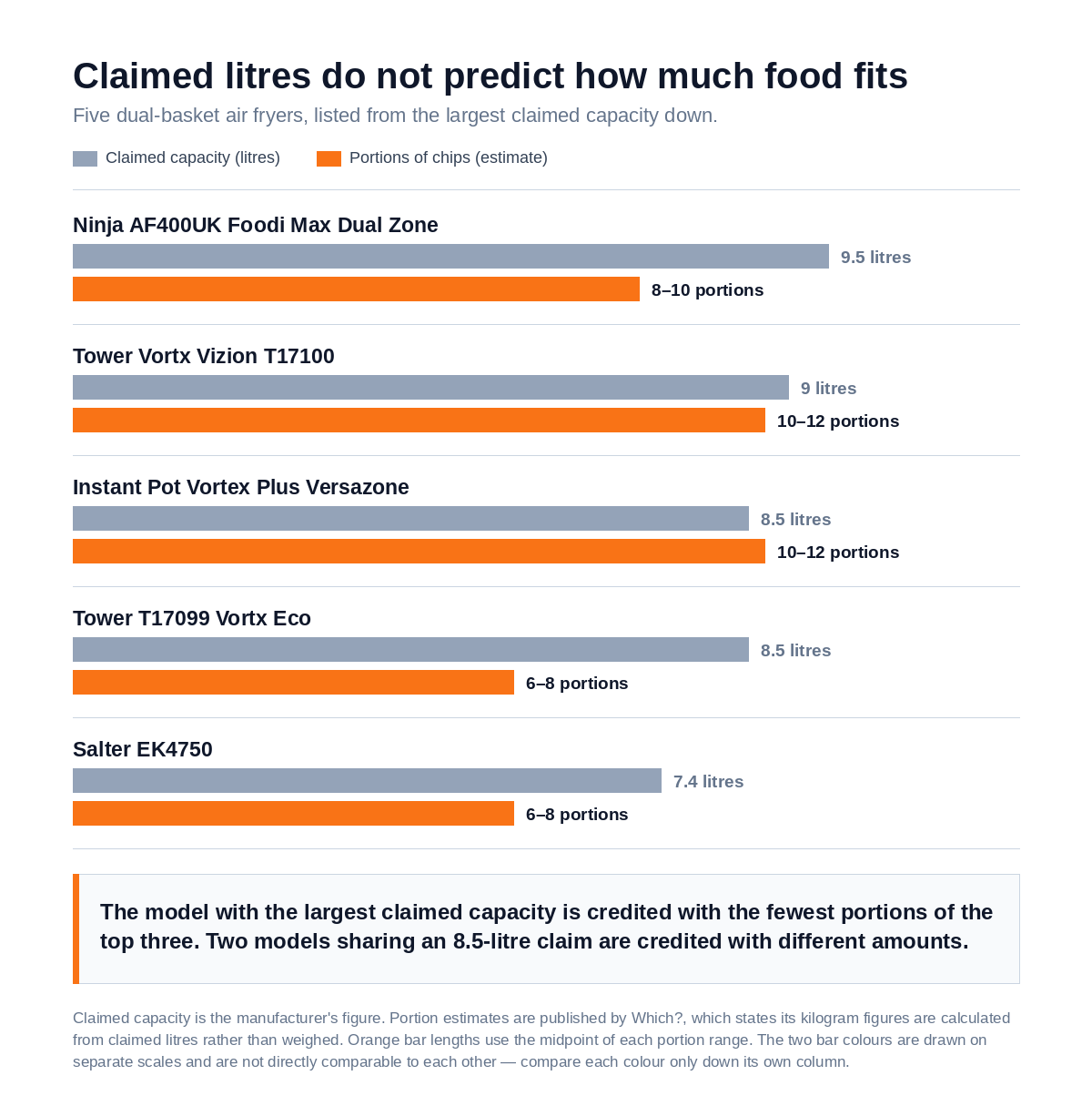
The number printed on an air fryer box is a volume figure. It is not a measurement of how much food the machine can cook. Those two things are far enough apart that, in figures published by one consumer testing organisation, a 9.5-litre model is credited with fewer portions of chips than an 8.5-litre one.
The short answer
Buy for the area of the basket floor, not the litre or quart rating. Food in an air fryer crisps because hot air moves around every side of it, and that only happens when food sits in a single layer. The practical capacity of any air fryer is therefore the floor area of its basket. The volume figure on the box measures something different: the total empty space inside, including all the headroom above the food that you can never usefully fill.
A rule that survives contact with a shop shelf: ignore the headline number, look at the basket footprint, and assume you will fit less in than the box implies. Below is the evidence, and what to check instead.
What the litre or quart number actually measures
Two independent consumer organisations have said plainly that the advertised figure overstates what you can cook.
Consumer Reports, which buys and tests air fryers from more than 40 brands, states in its air fryer buying guide: In our labs, we measure the actual usable capacity of the air fryers we test, and we often find that the space is smaller than the capacity claimed by the manufacturer.
That is an unusually blunt thing for a buying guide to say about the specification it is nominally helping you shop by.
The UK organisation Which? goes further and explains the mechanism. In its guide to common air fryer cooking problems, it writes that capacity is usually measured in litres
and that retailers or manufacturers indicate how many litres of liquid can fit in the basket.
Then the important sentence: However, this measure isn’t always the optimum capacity for best cooking results. Our tests show that the optimum cooking amount is generally significantly smaller than the manufacturers state.
Read that carefully. The litre rating answers the question how much water would this basket hold. Nobody cooks water. Which? says it publishes a figure in grams in its reviews instead, because we think it’s more useful
.
On its dual air fryer guide the same organisation adds the consequence most shoppers never consider: Manufacturers quote the total internal volume of their air fryers as a guide to size (in litres). But we find that this doesn’t always tally with our own measurements of how much food you can realistically fit inside, as not all the internal space is usable. It is possible for an air fryer with larger dimensions to have less space available for cooking than a smaller one.
A bigger box can be a smaller air fryer. That single sentence undoes the entire way these appliances are marketed.
Where the published numbers stop lining up
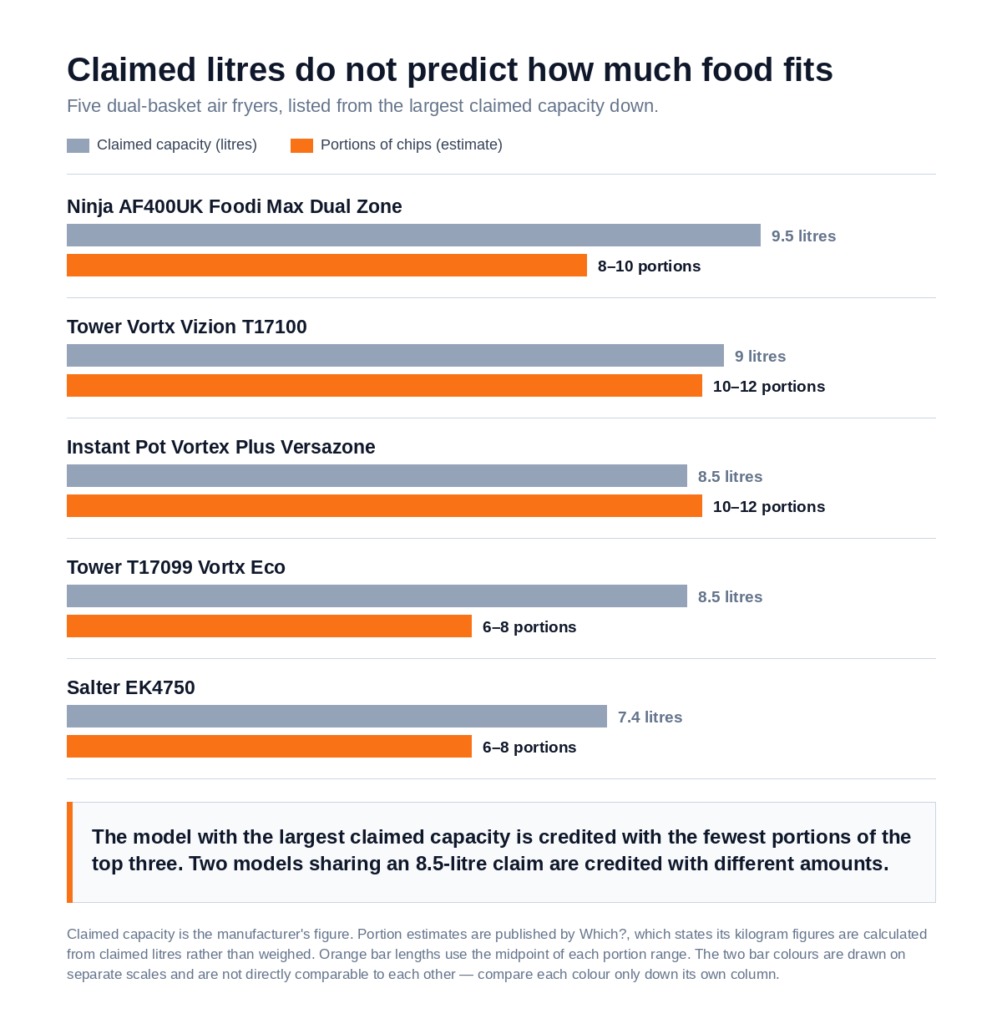
Which? publishes a table of the largest dual air fryers it has assessed. Set the claimed litre figure beside the portions of food it credits each model with, and the ranking scrambles.
| Model | Claimed capacity | Capacity (kg) | Portions of chips | Chicken thighs |
|---|---|---|---|---|
| Ninja AF400UK Foodi Max Dual Zone | 9.5 litres | 2.2 kg | 8 to 10 | 6 |
| Tower Vortx Vizion T17100 | 9 litres | 2.3 kg | 10 to 12 | 8 |
| Instant Pot Vortex Plus Versazone | 8.5 litres | 2.3 kg | 10 to 12 | 8 |
| Tower T17099 Vortx Eco | 8.5 litres | 2.1 kg | 6 to 8 | 4 to 5 |
| Salter EK4750 | 7.4 litres | 2.1 kg | 6 to 8 | 4 to 5 |
The model with the largest claimed volume is not the model credited with the most food. The 9.5-litre Ninja is placed at 8 to 10 portions of chips; the 8.5-litre Instant Pot at 10 to 12. And two models sharing an identical 8.5-litre claim are given different capacities, 2.3 kg and 2.1 kg. Whatever the litre figure is tracking, it is not tracking dinner.
An honest caveat about this table
This point needs a qualification that is routinely dropped when these numbers get repeated. Which? attaches a footnote to its own table: Claimed capacity in litres is measured by the manufacturer. Capacity in kg is a Which? calculation, based on the claimed capacity in litres. Amount of food is a Which? estimate.
So the kilogram column in that specific table is derived, not weighed. It would be wrong to present those figures as laboratory measurements, and this guide does not. The wider claim — that tested cooking capacity runs well below the stated volume — rests on the two organisations’ general statements quoted above, which are about their testing, not on this derived table.
That said, the internal inconsistency stands on its own terms and is worth noticing. If the kilogram figure were a straightforward conversion from litres, two models with the same claimed litres would produce the same kilograms, and a 9.5-litre model could not rank below an 8.5-litre one. They do not, and it does. Either way the shopper’s conclusion is the same: the litre number does not predict how much food comes out.
The constraint that actually sets your size
There is a physical reason usable capacity is lower than volume, and it is not a marketing trick. It is how the appliance works.
The US Department of Agriculture’s Food Safety and Inspection Service is direct about it in its guidance on air fryers and food safety: Air fryers generally don’t have a lot of room inside. Overcrowding the appliance can prevent enough air circulation to properly cook the food. When air frying a large amount of food, it may be best to do so in batches rather than all at once.
Note what kind of warning that is. It appears under the heading Cook
in a food safety document, alongside safe internal temperatures. The agency’s instruction is be sure not to overfill the air frying basket to avoid uneven cooking and undercooking.
Overfilling is not framed as a texture problem. It is framed as a route to undercooked food.
This is why buying a taller basket buys you very little. You cannot stack food two deep and get the same result, because the piece underneath is no longer surrounded by moving air. The usable space is a floor, not a box. Doubling the height of a basket roughly doubles the litre rating while adding nothing you can actually use for a single layer.
That single-layer rule is also the reason the USDA insists on a thermometer rather than a timer: Use a food thermometer to make sure your meat and poultry is fully cooked.
Cooking times published for an air fryer assume the basket is not crowded. Load it heavily and the published time silently becomes wrong.
Translating a household into a basket
Because portions are a more useful unit than litres, the table below converts the Which? food estimates into the question you are actually asking. Treat these as rough planning figures, not specifications.
| Cooking capacity | Roughly equals | Realistic for | Batch cooking? |
|---|---|---|---|
| 0.6 kg | Around 2 portions of chips | One person, or a side dish for two | Yes, for almost any main meal |
| 2.1 kg | 6 to 8 portions of chips, or 4 to 5 chicken thighs | Three to four people | Occasionally |
| 2.2 kg | 8 to 10 portions of chips, or 6 chicken thighs | Four to five people | Rarely |
| 2.3 kg | 10 to 12 portions of chips, or 8 chicken thighs | Five or more, or batch cooking | Rarely |
Two things stand out. First, the entire tested range of dual air fryers spans roughly 0.6 kg to 2.3 kg of food. That is the whole market, from smallest to largest, in less than a factor of four — despite claimed volumes that look far more dramatic on a box.
Second, Which? describes 2.3 kg, the top of that range, as more than 10 portions of chips
, and notes that some dual air fryers are large enough to accommodate a full chicken.
If your requirement is genuinely larger than a whole chicken, an air fryer is the wrong appliance and no amount of extra litres will fix it.
Why this guide will not give you a single quart number
Almost every article on this question ends in a tidy table: two people, three litres; family of four, six litres. This one does not, for a reason worth stating.
Those tables are built on the litre figure. If the litre figure does not reliably predict how much food fits — and both organisations quoted above say it does not — then a recommendation expressed in litres inherits the same unreliability. Telling you “six litres for a family of four” sounds helpful and is, at best, a rough proxy for a measurement nobody printed on the box.
What holds up better is a procedure:
- Decide the largest single thing you want to cook flat. Four chicken thighs? A whole small chicken? Two salmon fillets and a tray of vegetables at once? That item, laid in one layer, is your true minimum.
- Find the basket’s internal floor dimensions, not its volume. Manufacturers rarely lead with this, but it is often in the manual or the specification sheet, and it is the number that answers your question.
- Check whether the review source reports capacity in weight. A figure in grams or kilograms has been reasoned about. A figure in litres has been poured.
- Accept batch cooking for the outliers. Sizing for the one big meal a year means living with an oversized appliance for the other 364 days.
The cost that is not on the price tag
Air fryers are counter appliances, and counter space is finite. Consumer Reports frames the whole category this way: Air fryers are designed to fit on a counter. Most aren’t big enough to cook for a crowd unless you cook in batches.
That is the trade being offered. A larger machine reduces batching and takes permanent counter territory. Which? notes of dual models that they generally take up more room and tend to cost more to run.
Because the litre rating scales with the whole cabinet and not the usable floor, a machine that is much bigger on your worktop may be only slightly bigger where it counts.
There is a maintenance dimension too. A bigger basket is a bigger non-stick surface to look after, and non-stick coatings are consumable rather than permanent — see our guide on when to replace an air fryer basket. Larger machines also collect more fat around the element, which is the usual source of smoking during cooking.
Basket or oven style?
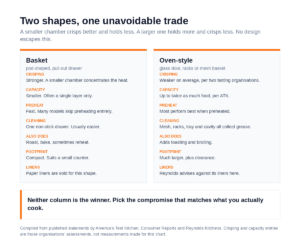
Size and format are tangled together, because the easiest way to get more usable floor area is to change format rather than buy more litres.
Consumer Reports notes that tray or rack models allow you to cook vegetables, meats, and sides simultaneously, and often take up the same amount of counter space as models with a basket.
Multiple racks multiply floor area without multiplying footprint, which is exactly the variable that matters.
The trade-off is crisping. Consumer Reports attributes air fryer performance partly to the relatively small, concentrated space in which hot air circulates
, and reports that air-frying toaster ovens often can’t achieve the same level of crispiness as true air fryers.
More room and more crisp pull in opposite directions. This is the subject of a separate comparison, and this guide will not pretend to settle it in three paragraphs.
What this guide cannot tell you
- Which specific model to buy. No independently measured usable-capacity figures for named current models were located that could be reproduced here, so no model is recommended.
- The usable floor area of any particular basket. Manufacturers do not publish this consistently, and it was not possible to verify dimensions across brands.
- How much a stated litre figure typically overstates usable capacity. Both organisations say usable capacity is lower. Neither publishes a general percentage that could be verified here, and the widely repeated figure attributed to Which? could not be confirmed on a page that loaded.
- Whether quart and litre ratings are measured to any common standard. No published measurement standard governing how manufacturers derive the figure was located.
- Whether a larger air fryer costs more to run per meal. Which? states dual models
tend to cost more to run
, but no per-portion energy comparison was found.
Frequently asked questions
Is a bigger air fryer always better?
No, and not only for counter-space reasons. Which? states directly that it is possible for an air fryer with larger dimensions to have less space available for cooking than a smaller one.
Larger external size does not guarantee more usable cooking area.
Can I just fill the basket and cook for longer?
This is the workaround people reach for, and it is the one the USDA warns against. Its guidance is to be sure not to overfill the air frying basket to avoid uneven cooking and undercooking
and to cook in batches instead. Extra time does not reliably fix a crowded basket, because the problem is air that cannot reach the food. If you do cook a heavy load, verify the internal temperature with a thermometer rather than trusting the clock.
Do two baskets give me twice the capacity?
They give you two independent cooking floors, which is genuinely useful, but the totals stay modest. The largest dual models Which? lists top out around 2.3 kg of food. Which? also describes a feature on some models, a removable zone divider, that converts two zones into one larger one for particularly large items of food that can’t fit in just one smaller basket.
Does a liner reduce my usable capacity?
It can affect airflow, which is a related but separate question, and it comes with its own set of rules. We cover this in detail in our guide to parchment and silicone air fryer liners, and the same airflow logic applies to using foil in an air fryer.
Should I size up for wet batter or baking?
Size is not the limiting factor here. Which? advises that you should never attempt to pour wet batter straight into the basket
, because air fryers blow hot air around the basket, so important heating elements could get covered and prevent the appliance from working correctly.
For cakes it recommends a tin or mould inside the basket — which itself occupies floor area, so factor the dish, not just the food.
Related reading
- When should you replace an air fryer basket?
- Is air fryer non-stick coating safe?
- How to clean an air fryer heating element
- Why does my air fryer smell like plastic?
- Why is my air fryer smoking?
- Parchment paper and silicone liners: the safety rules
Sources: Consumer Reports air fryer buying guide, updated 20 November 2025; Which?, “Air fryer recipe fails: what causes them and how to fix them”, updated 15 May 2026; Which?, “Best dual air fryers”, updated 1 July 2026; US Department of Agriculture, Food Safety and Inspection Service, “Air Fryers and Food Safety”, last updated 24 June 2024. Capacity figures attributed to Which? are that organisation’s published claims and estimates, described in its own footnote as calculated from manufacturer-claimed litres rather than independently weighed. Our approach to sourcing is described in how we research.