Why Does Food Cook Unevenly in an Air Fryer?
Food usually cooks unevenly in an air fryer because the basket is too crowded or the food was not shaken, turned or rearranged during cooking. Hot air moves around the basket, but it does not reach every surface equally: the top sits closer to the heating element, the tray blocks part of the underside, and overlapping pieces shield one another.
Start with a smaller, uniform batch in one layer and turn it halfway through. If the same physical side of the basket still browns faster over several controlled batches, move from a cooking-technique diagnosis to a model or appliance diagnosis.
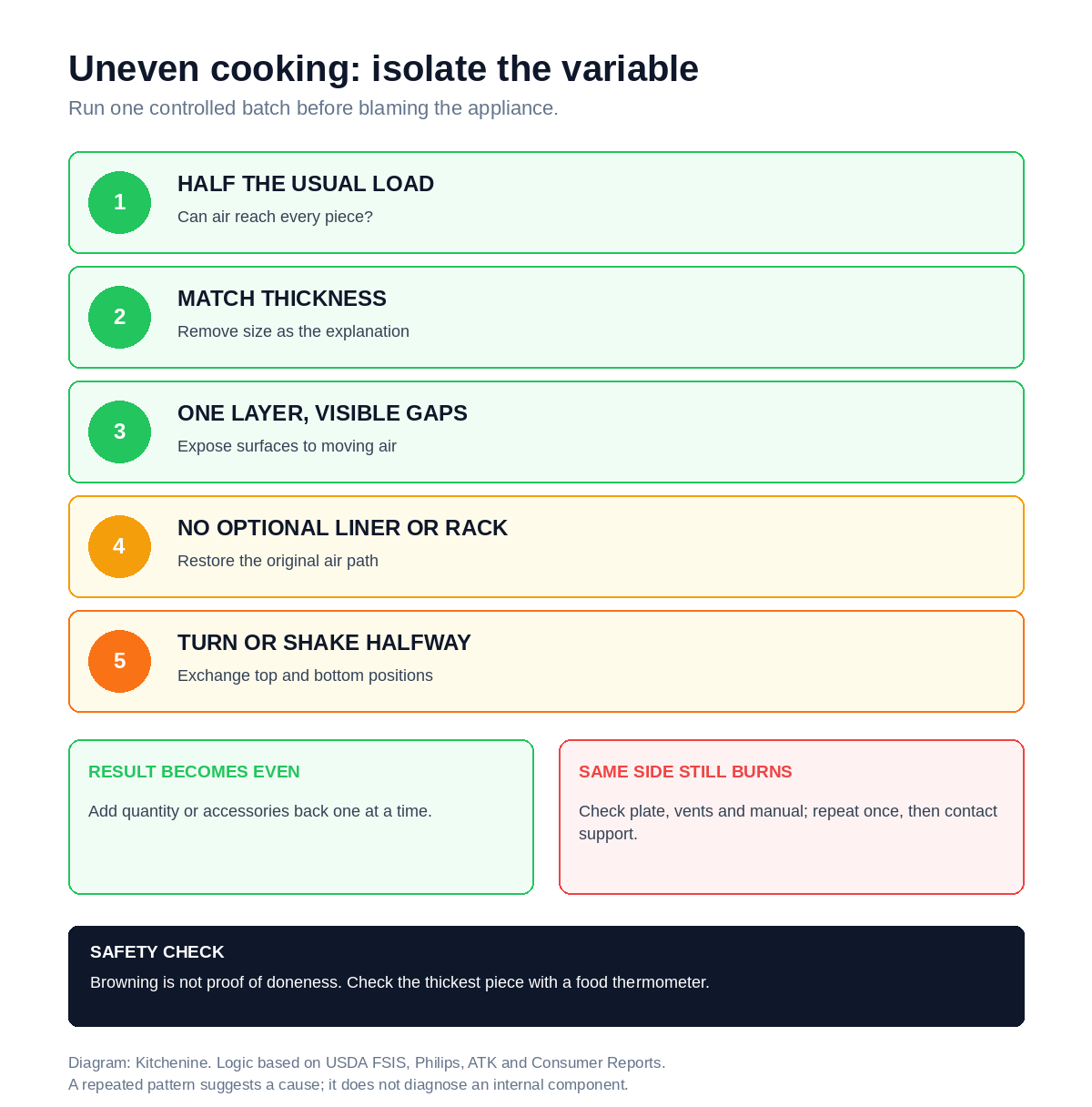
The five-variable test
Do not change temperature, time, load, food size and accessories all at once. You will get a different result without learning why. Run one controlled batch:
- Use half your usual quantity.
- Cut or select pieces of similar thickness.
- Arrange them in one layer with visible gaps.
- Remove any optional liner, dish or rack for this test.
- Turn large pieces or shake small pieces halfway through.
If that batch cooks evenly, the appliance can distribute heat adequately under a light load. Add quantity or an accessory back one at a time until the problem returns.
| Pattern you see | Most likely first check | First change |
|---|---|---|
| Top brown, underside pale | Food not turned; tray shielding underside | Flip halfway through |
| Outside pieces brown, centre pile pale | Overcrowding | Reduce load and expose gaps |
| Small pieces burn, large pieces stay firm | Uneven size | Cut to similar thickness |
| Bottom stays wet when using a liner or dish | Blocked airflow | Remove accessory for a control batch |
| Same basket corner burns every time | Installation, airflow or appliance hot spot | Check plate, vents and manual; contact support if repeated |
1. The basket is too crowded
Air fryers cook by moving hot air around food. USDA warns that overcrowding can prevent enough circulation to cook food properly and recommends batches for larger quantities. Consumer Reports reaches the same practical conclusion: crowding keeps hot air from reaching every piece, slowing cooking and producing uneven, soggy results.
A maximum-fill line is not a promise of maximum crispness. It is a loading limit. Philips says smaller portions air-fry more evenly and recommends a single layer for snacks when possible.
Surface area matters more than the volume printed on the box. A deep basket can hold many fries while giving only a small fraction direct exposure to airflow. This is why our guide to air fryer size and usable capacity focuses on basket shape rather than litres alone.
2. Moving air does not remove the need to turn food
America’s Test Kitchen explains the apparent contradiction. The fan circulates air, but the chamber is confined, the powerful heating element is usually above the food, and the basket or tray blocks some air from reaching the underside. The top therefore receives both circulating air and stronger radiant heat.
Turn larger pieces such as burgers, chops and cutlets around halfway. Shake or toss fries, florets, nuggets and other small pieces so food from the lower layer reaches the top.
Philips says every ingredient cooked in more than one layer should be shaken, stirred or turned. At its maximum recommended frozen-fries quantity, it recommends at least three to four shakes and says more food requires more frequent shaking. That is model guidance, not a universal timer; your manual and recipe remain controlling.
3. The pieces are not comparable
Equal time does not produce equal doneness when thickness, starting temperature or moisture differs. A thin potato strip has more surface relative to its centre than a thick one, so it loses water and browns sooner. A partially frozen piece absorbs heat differently from a thawed piece beside it.
For a useful test, match thickness rather than chasing perfect shape. Pat wet surfaces dry when browning is the goal. Consumer Reports specifically recommends uniform potato pieces and drying them before air frying.
Do not mistake exterior colour for safe internal temperature. USDA says poultry must reach 165 °F, ground meat 160 °F, fish 145 °F, and whole cuts of beef, pork, veal and lamb 145 °F followed by a three-minute rest. Check the thickest piece with a food thermometer.
4. An accessory is redirecting or blocking airflow
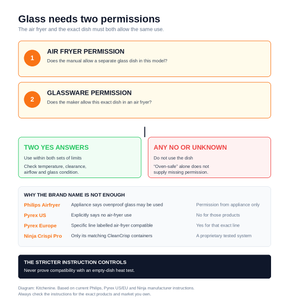
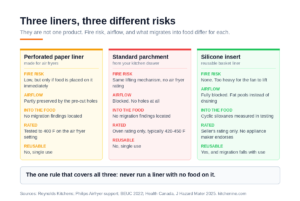
A solid liner, silicone bowl or glass dish catches drips because it blocks them. The same barrier also blocks part of the air path beneath the food. Perforations do not guarantee that the original airflow is preserved, especially when food covers them.
Run one batch without the optional accessory. If the underside improves, the accessory is part of the trade-off. That does not automatically make it unsafe; it means cooking time, turning frequency and expected crispness may change. Read our air fryer liner safety rules before changing liner type.
Stacking racks create another version of the same issue. They increase capacity but place food at different distances from the element. Rotate rack positions or food only when the model instructions permit it.
5. The selected preset does not match the food
A preset label can hide a narrower assumption. In Consumer Reports’ home evaluation, a fish preset produced rubbery black cod; the manual later showed that the preset was intended for fish sticks, not fresh fish.
Use presets as starting programs, not ingredient recognition. Check whether the manual defines portion, frozen or fresh state, and thickness. Cooking times vary between models because chamber size, power control, fan behaviour and food load differ. That variation is the subject of the next article in this series.
6. The crisper plate or basket is installed incorrectly
A plate sitting at an angle changes the gap beneath the food. Missing rubber feet, a warped plate or a basket that does not seat fully can also alter the intended air path.
- Let everything cool and unplug the appliance.
- Remove and reinstall the crisper plate according to the manual.
- Check that removable feet and supports are present and undamaged.
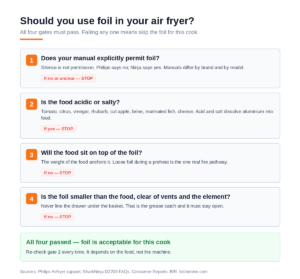
- Confirm that no foil, liner or residue blocks basket holes or intake/exhaust vents.
- Do not bend a plate back into shape while it is installed.
If the basket or plate is damaged, compare the signs in when to replace an air fryer basket.
When uneven cooking may be an appliance problem
Suspect the appliance only after a controlled batch still shows the same pattern. Use uniform pieces in one uncrowded layer, no optional accessory, and turn them once. Repeat on another day.
Contact the manufacturer if:
- the same fixed corner repeatedly burns while the opposite side stays underdone;
- the fan sounds different, stops intermittently or no longer moves lightweight crumbs as it previously did;
- the appliance cannot reach safe internal temperature within a reasonable extension of the manual’s guidance;
- an error code, burning electrical smell, sparking or damaged cord appears.
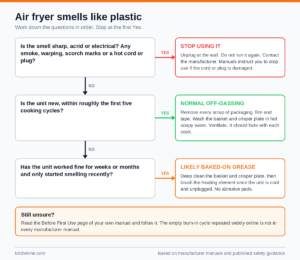
Stop using the appliance for electrical smells, smoke not explained by food or grease, sparking, or cord damage. Do not open the housing to inspect the fan or wiring.
A practical order of fixes
- Reduce the load.
- Make thickness and starting condition more uniform.
- Shake, turn or rearrange during cooking.
- Remove optional liners, dishes or racks for a control batch.
- Verify the preset and manual instructions.
- Reinstall and inspect removable cooking parts.
- Contact support if a fixed hot spot remains.
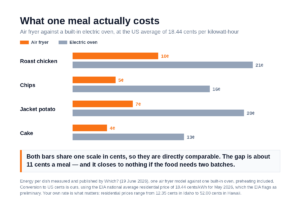
Batching has an energy consequence. If one meal needs two or three cycles, the air fryer’s advantage over a full-size oven can shrink. See the measured comparison in do air fryers use a lot of electricity?
What this article cannot tell you
- The correct time and temperature for an unidentified model and load.
- Whether a fixed hot spot is caused by the fan, element, sensor or control board.
- How much stacking your specific basket can tolerate while still cooking evenly.
- Whether a third-party rack or liner preserves the airflow the appliance was designed around.
Frequently asked questions
Why is the top cooked but the bottom is pale?
The top is closer to the heating element while the tray and food block part of the underside. Turn large pieces halfway and avoid solid accessories during a control test.
How often should I shake the basket?
Follow the recipe and model manual. Philips says food in more than one layer needs shaking and that larger loads require it more often; its maximum frozen-fries load requires at least three to four shakes on covered models.
Does an air fryer need one layer only?
One layer is the clearest diagnostic and usually the most even arrangement. Some small foods can be stacked within a manufacturer’s limit if they are shaken enough to exchange top and bottom positions.
Should I preheat to fix uneven cooking?
Only if the manual or recipe calls for it. Preheating can improve consistency at the start, but it cannot create airflow through an overcrowded pile or a solid dish.
Why does only one side keep burning?
First reinstall the plate, clear vents and repeat a small controlled batch. If the same physical side still runs hotter, document the result and contact the manufacturer rather than opening the appliance.
Sources: USDA FSIS, Air Fryers and Food Safety (updated 24 June 2024); Philips support, Why Do I Have to Shake the Food?; America’s Test Kitchen, Do I Need to Flip My Food? (10 July 2023); and Consumer Reports, How to Get the Most From Your Air Fryer (updated 5 February 2024). Consumer Reports labels its eight-staffer home trial anecdotal and separate from its ratings; this article preserves that limitation.