Why Is My Air Fryer Smoking? Causes, Fixes, and When to Stop
Smoke coming out of an air fryer is common, and most of the time it is grease rather than a fault. But not always. The difference matters, because one version is a cleaning job and the other means you should unplug the appliance and stop using it.
The short answer
White or grey smoke during cooking is almost always fat. Grease has dripped onto the heating element, or splattered onto the interior ceiling, and is burning off. Thin blue-white smoke from fatty foods like bacon, sausage, or well-marbled steak is the same thing happening in real time.
Three situations are different, and none of them are a cleaning problem:
- Black smoke. Stop. This is covered separately below.
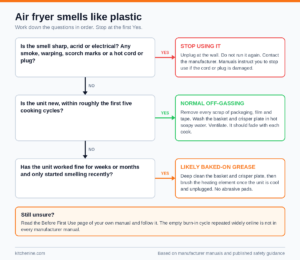
- A burning plastic or electrical smell alongside the smoke. Unplug it.
- Smoke on a brand new unit that has never cooked anything. That is a different problem, and we cover it in our guide to the plastic smell in a new air fryer.
First: is it actually smoke?
Steam and smoke look similar coming out of a rear vent, and people often assume the worst. Two quick checks separate them.
Steam is odourless, appears with high-moisture foods like vegetables or frozen items, and disperses quickly. Smoke has a smell — burnt, greasy, or acrid — and tends to keep coming for as long as the appliance runs. If what you are seeing has no smell at all and you are cooking something wet, it is almost certainly steam.
The five things that actually cause it
| Cause | What you will notice | Fix |
|---|---|---|
| Grease baked onto the heating element | Smoke starts within a minute or two, often before the food is warm. Happens regardless of what you cook. | Clean the element and the interior ceiling. This is the single most common cause. |
| High-fat food rendering | Smoke begins partway through cooking bacon, sausage, burgers, chicken thighs, or fatty fish. | Add a little water to the drawer beneath the basket, or cook in smaller batches. |
| Oil past its smoke point | Smoke with a sharp, bitter smell. Food tastes harsh. | Switch to an oil rated above your cooking temperature. See the table below. |
| Overcrowding, or food touching the element | Smoke plus uneven cooking. Light foods rise into the element under the fan. | Cook in batches. Weigh light items down. |
| Aerosol cooking spray residue | Gradual onset over weeks. A sticky, varnish-like film on the basket. | Stop using aerosol sprays. Use a refillable mister with plain oil. |
That last one surprises people. The LSU AgCenter’s air fryer publication advises using 100% oil in oil mister/sprayer
and states plainly: Do not use nonstick cooking oil sprays/aerosols. These products contain additives that could harm air fryer or cooking process.
Those additives are the propellants and lecithin emulsifiers, and they polymerise into a residue that ordinary washing does not lift.
The oil question
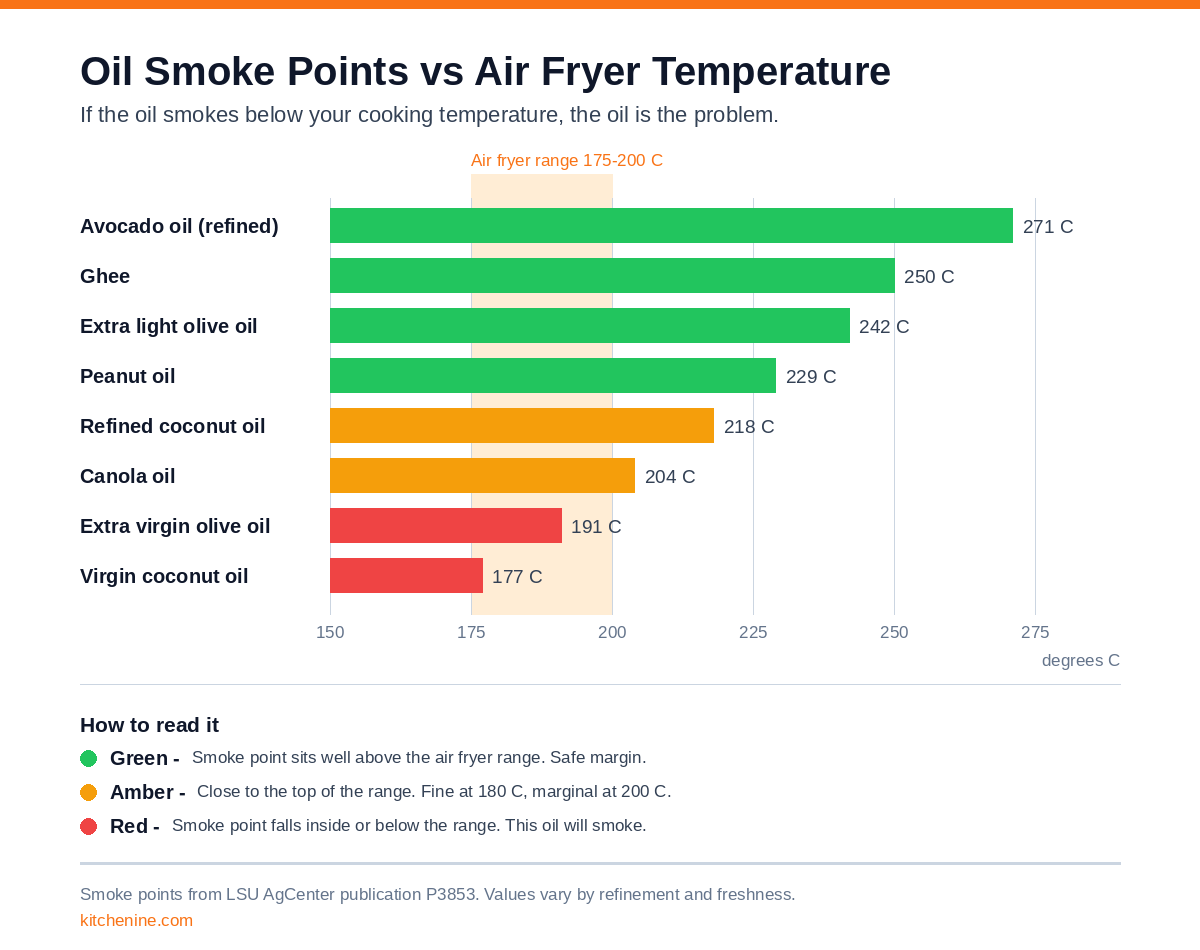
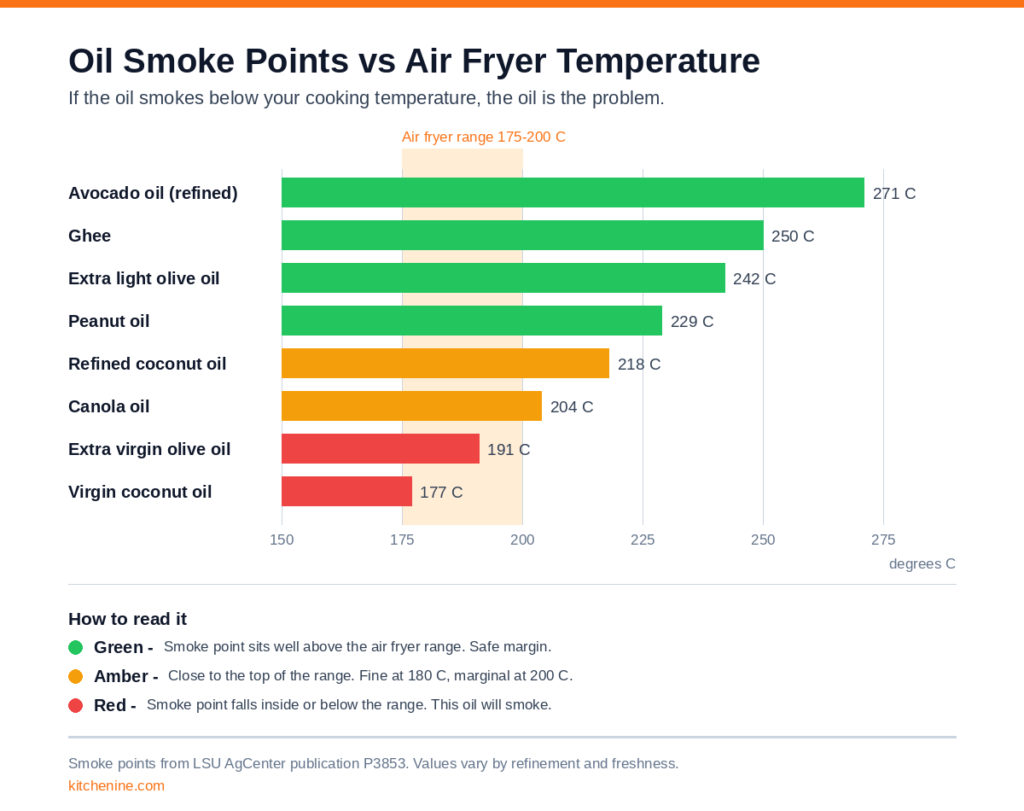
Every oil has a smoke point — the temperature at which it starts to break down. The USDA’s Food Safety and Inspection Service describes it as the point where the oil begins to break down and can have a foul odor or taste.
Most air fryers run between 175 °C and 200 °C (350–400 °F), and many top out at 200 °C or a little above. So the rule is simple: your oil’s smoke point must sit above your cooking temperature, with margin.
| Oil | Approximate smoke point | Safe at 200 °C / 400 °F? |
|---|---|---|
| Avocado oil (refined) | 520 °F / 271 °C | Yes, with wide margin |
| Ghee | 482 °F / 250 °C | Yes |
| Extra light olive oil | 468 °F / 242 °C | Yes |
| Peanut oil | 445 °F / 229 °C | Yes |
| Refined coconut oil | 425 °F / 218 °C | Yes, narrow margin |
| Canola oil | 400 °F / 204 °C | Marginal — at the limit |
| Extra virgin olive oil | 375 °F / 191 °C | No |
| Virgin coconut oil | 350 °F / 177 °C | No |
These figures come from the LSU AgCenter publication. Published smoke points vary between sources by 10–20 degrees depending on refinement and freshness, so treat them as a guide rather than a precise threshold. Extra virgin olive oil at 200 °C is the most common avoidable mistake.
How to fix it, in order
- Unplug and let it cool completely. Nothing below should be attempted on a warm appliance.
- Wash the basket and crisper plate in hot soapy water. Do not use abrasives — Ninja’s manual for the AF100 series instructs owners:
DO NOT clean with abrasive cleaners, steel wool, or scouring pads.
Scratching the coating creates a new problem, which we cover in our guide to non-stick coating safety. - Clean the heating element. This is the step most people skip, and it is the one that usually solves the problem. Ninja’s cleaning instructions include a specific step to
Clean the heating element with a cleaning brush to remove any food residues.
Tilt the unit so you can see the element, and use a damp cloth or soft brush — not a soaking wet sponge, and never spray liquid directly at it. - Wipe the interior ceiling and walls. Residue up there drips down onto the element during the next cook.
- Check the vents. Ninja’s safeguards warn that blocking the intake or outlet vents
may damage the unit or cause it to overheat.
The CCPC gives the same advice: do not place the appliance against a wall or another appliance, and do not cover the vents. - Run it empty for a few minutes at a moderate temperature to burn off traces of moisture, with a window open. If smoke continues after a full clean, the problem is not grease.
For fatty foods specifically, a tablespoon or two of water in the drawer under the basket stops rendered fat from reaching smoking temperature. This works, and it is a widely repeated tip — but check your own manual first, because not every design has a drawer that tolerates it.
When to stop and unplug
Ninja’s manual is unambiguous about black smoke: if it appears, unplug the unit and wait before removing the basket. That instruction exists because opening a drawer feeds oxygen to something that may already be burning.
The CCPC’s guidance is broader and worth following regardless of brand: If you notice strange or burning smells or smoke, turn off immediately and report to the manufacturer.
Stop using the appliance entirely if any of these apply:
- Thick smoke continues after a thorough clean
- You smell burning plastic or an electrical smell
- The unit trips a breaker, or the plug or cord feels hot
- You see any flame, scorching, or melted plastic
- The power cord or plug is damaged — Ninja’s safeguards state:
DO NOT use the appliance if there is damage to the power cord or plug.
If there is a fire, do not use water
This is worth knowing before you need it. USDA FSIS states: In the event of a grease fire, never use water to put out the fire. Using water can cause flaming oil to splatter and spread.
The agency recommends a kitchen fire extinguisher or smothering, and calling emergency services immediately.
Ireland’s National Directorate for Fire and Emergency Management makes a related point about preparation rather than response. Ray Hamill, Assistant Fire Adviser, said: The single most important measure every home can take is to install and maintain working smoke alarms, as they provide the earliest warning of a fire.
Sometimes it is the appliance, not you
Air fryers have been recalled for overheating, and the numbers are not trivial.
In February 2023, Cosori air fryers were recalled jointly by Health Canada, the US CPSC, and Mexico’s PROFECO because the wire connectors in the products can overheat, posing a potential burn and fire hazard.
Health Canada’s notice records 205 reports globally of the appliances catching fire, burning, melting, overheating and smoking
, along with 23 reports of minor property damage and 10 reports of minor burn injuries. Over two million units were sold in the United States alone.
A smaller recall followed in May 2026, when Secura air fryers with model number SAF-53 and date codes 1903 and 1904 were recalled in Canada for the same underlying reason: A wire connection in the air fryer can overheat, posing fire and burn hazards.
If your unit smokes without a grease cause, check whether your model and batch number appear on a recall list. The model number is usually on a label on the underside.
It is worth balancing this against testing evidence. Ireland’s CCPC investigated air fryers on the market and had a variety of models tested by an independently accredited laboratory. It reported good levels of compliance with applicable product safety legislation, with no significant safety concerns identified among the air fryers tested.
Recalls are real, but they are the exception rather than the pattern.
Cleaning is the actual prevention
CCPC research found that 73% of people surveyed own an air fryer and 41% of those owners use it every day — but fewer than half of daily users clean it daily, 7% of daily users clean it about once a month, and 3% of owners say they never clean it at all.
That gap is where most smoke comes from. Cleaning the basket after each use and the element roughly monthly, depending on how much fat you cook, prevents the buildup before it starts.
What this guide cannot tell you
- Whether your specific unit has a fault. Persistent smoke after cleaning needs the manufacturer, not an article.
- Whether adding water to your drawer is safe on your model. Your manual governs.
- Exact smoke points for your oil. Refinement and freshness shift the number.
- Whether your model is under recall today. Recall lists change; check the current one.
- We attempted to read the CPSC’s own recall pages directly for this article and both returned server errors, so the recall details above are taken from Health Canada’s parallel notices for the same joint recalls.
Frequently asked questions
Is a little smoke normal?
With fatty foods, yes — brief, thin smoke that stops when cooking ends is ordinary fat rendering. Persistent or thick smoke is not.
Can I put water in the bottom to stop smoke?
On many basket models, a small amount of water in the drawer beneath the basket works. Confirm against your manual first, and never pour water onto the heating element.
Why does it smoke even when empty?
Residue on the element or ceiling. An empty run does not remove grease; it burns it. Clean first, then run empty.
Is the smoke dangerous to breathe?
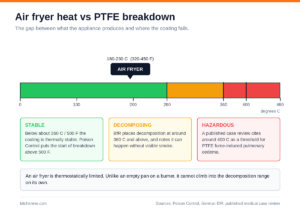
Burning fat produces the same kind of smoke as a hot frying pan. Ventilate the room. A separate concern applies if a non-stick coating is overheating rather than fat — Germany’s BfR notes that PTFE decomposition begins around 360 °C and can occur without visible smoke formation
, which is well above normal air fryer operating temperatures. See our coating safety guide.
Should I replace the basket if it is stained?
Staining alone is cosmetic. Flaking or deep scratching is different. We cover the distinction in when to replace an air fryer basket.
Related reading
- How to clean an air fryer heating element
- Why does my air fryer smell like plastic?
- Is air fryer non-stick coating safe?
- When should you replace an air fryer basket?
Sources: Competition and Consumer Protection Commission (Ireland) air fryer safety campaign and research, 19 July 2026; USDA Food Safety and Inspection Service, Deep Fat Frying and Food Safety; LSU AgCenter publication P3853, An Overview of the Air Fryer; Health Canada recall RA-72618 (Cosori, 23 February 2023) and RA-82098 (Secura, 22 May 2026); Ninja AF100 series owner’s manual; German Federal Institute for Risk Assessment (BfR) on PTFE-coated cookware. Our method is described in how we research.