Air Fryer vs Convection Oven: What’s Actually Different Inside?
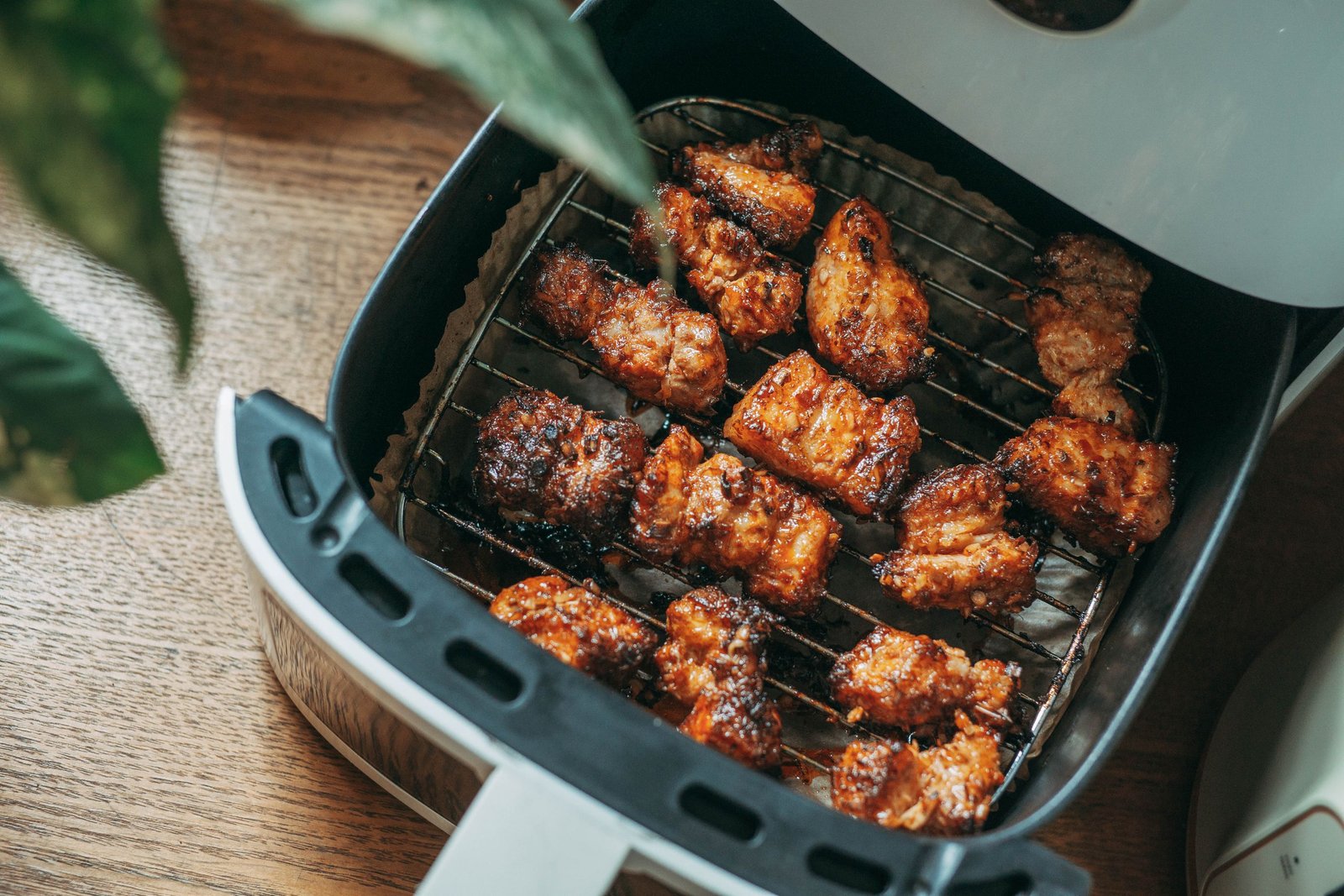
An air fryer is a convection oven, but that does not make the two appliances interchangeable. Both move hot air around food. A dedicated air fryer usually does it inside a much smaller chamber, with faster airflow directed close to the food and a perforated basket that exposes more of its surface. A full-size convection oven gives that air much more space to cross and gives the cook far more room to use.
That is the real distinction. “Air frying” is not a separate cooking process. It is convection baking arranged to favour rapid surface drying and crisping.
The short answer
| If you mainly cook… | The stronger fit | Why |
|---|---|---|
| One or two portions of fries, wings, vegetables or leftovers | Dedicated air fryer | Small chamber, concentrated airflow and little preheating favour fast crisping |
| Several trays, a family meal or multiple dishes together | Convection oven | Capacity can remove the need for repeated batches |
| Cakes, cookies and breads | Depends on the recipe | Forced air can brown too quickly or disturb foods that need time to rise |
| Roasts that benefit from an evenly browned exterior | Either | Both use moving air; capacity and portion size decide which is practical |
| The crispest result from a small portion | Dedicated air fryer | Independent evaluations favour its more concentrated blast of heat |
What happens inside both appliances
In an ordinary oven, hot air surrounds the food but moves relatively slowly. Moisture leaving the food can remain close to its surface as a thin layer of water vapour. That layer slows further evaporation.
A fan changes the process. America’s Test Kitchen explains that moving air continually strips away that insulating vapour layer, allowing the surface to dry, heat, brown and crisp more quickly. That is forced convection, whether the appliance is called a wall oven, countertop oven or air fryer.
The USDA Food Safety and Inspection Service uses equally direct language: air fryers are essentially countertop convection ovens.
America’s Test Kitchen goes one step further: When you buy an air fryer, you’re buying a convection oven. When you eat “air-fried” food, you’re eating baked food.
So the marketing name is misleading. Air does not fry food in the way hot oil does. Oil transfers heat quickly and drives moisture from the surface in a way moving air can imitate only partially. An air fryer can produce a dry, crisp exterior with little oil, but it does not turn baking into deep-frying.
The four differences that change the result
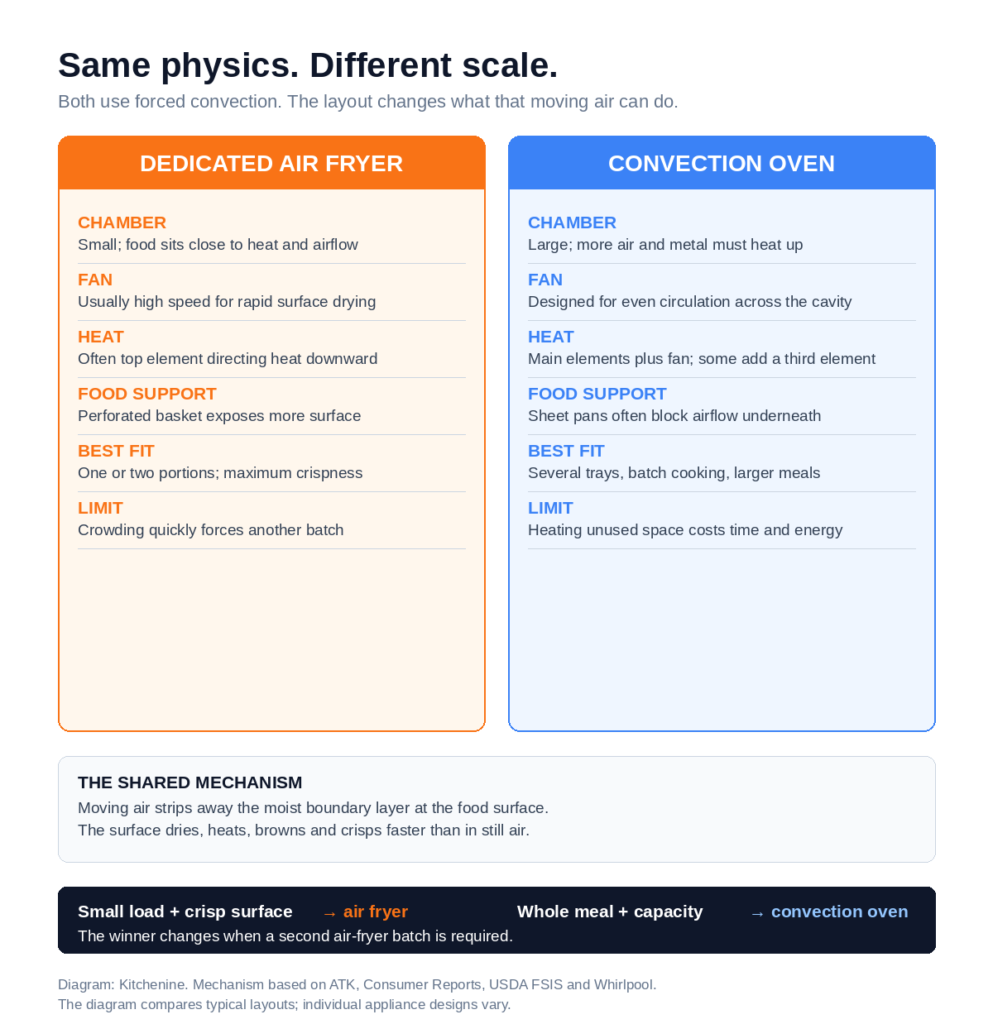
1. Chamber size
A dedicated air fryer heats a small cavity. Less internal space generally means less air and less metal to bring up to temperature. It also places the food closer to the heating element and moving airstream.
The full-size oven pays for its capacity every time it heats an almost empty cavity. But that same capacity becomes an advantage when the food fills it. An oven can cook several trays or dishes at once; a basket air fryer may have to repeat the cycle two or three times.
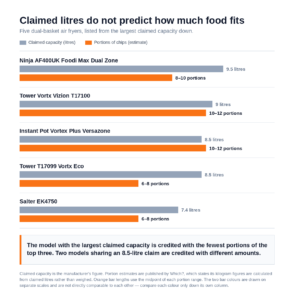
This is why capacity cannot be reduced to litres or quarts. The shape of the cooking surface and how much food fits in one layer matter more. Our guide to choosing an air fryer size shows how claimed volume can disagree with usable capacity.
2. Air speed and direction
Air frying is usually done with high fan speed. Classic convection ovens may move air more slowly because they are designed to encourage even cooking across a large cavity, rather than to attack one small basket with the fastest possible surface drying.
Consumer Reports describes air-fry mode in a toaster oven as convection with the fan running faster and directing a hot airstream onto the food. Its evaluations suggest that a dedicated air fryer will probably produce a crisper result because the smaller chamber concentrates that heat.
That conclusion is qualified, not absolute. Consumer Reports says probably
, and the often-repeated claim that it can be about 40% quicker comes from a staff member who cooked with both at home, not from the laboratory comparison described on the page. We do not treat that percentage as a measured rule.
3. Heating elements
Many drawer air fryers place the heating element and fan above the basket, directing heat down into a shallow chamber. Full-size convection ovens vary: they may use the main oven elements with a fan, or add a third element around the fan in a “true convection” design.
Whirlpool, which sells both appliances, notes that many air fryers cook from the top and have no bottom element, while convection ovens typically combine their oven elements with a fan. That is useful mechanical detail, but it is also a manufacturer’s explanation on a page selling air-fry ranges, not an independent performance test.
4. The surface holding the food
A basket or mesh rack lets air reach the top, bottom and sides of the food. A solid sheet pan blocks the underside. Consumer Reports identifies this perforated basket as part of the difference between convection and air-fry modes in the same toaster oven.
You can bring a convection oven closer to air-fryer behaviour by using a perforated basket or low-sided pan, leaving space between pieces and turning the food. You cannot make the cavity smaller without buying a smaller appliance, so the result may become similar without becoming identical.
Does an air fryer actually make food crisper?
For a small amount of food, usually. The mechanism supports it and independent evaluations lean the same way. Smaller space, stronger local airflow and exposure beneath the food all accelerate surface drying.
But “crisper” does not mean “cooks evenly without intervention.” USDA warns that overcrowding can prevent enough circulation to cook food properly. America’s Test Kitchen likewise found that overfilling causes poor browning and uneven cooking. Shaking or turning still matters because the basket, neighbouring pieces and the food’s own shape interrupt the air.
The limitation appears even in measured cooking results. In Which?’s chips comparison, the air fryer produced some perfectly cooked chips while those at the bottom were undercooked. The electric oven was inconsistent too, with some chips becoming too crisp. Both received middling quality scores. The appliance name did not rescue either one from food placement.
Which cooks faster?
The air fryer often starts faster because its cavity is smaller, but convection does not guarantee a shorter total cooking time. America’s Test Kitchen found that moving air cooks the surface faster while heat still needs time to reach the centre. The ratio of surface area to volume matters.
A thin layer of fries can respond strongly to rapid airflow. A dense roast can brown quickly outside while its centre still follows the slower physics of heat penetration. This is why converting every oven recipe by one fixed percentage is unreliable.
In Which?’s specific comparison, including preheating where required, the air fryer was faster for all four foods:
| Food | Air fryer | Built-in electric oven | Time difference |
|---|---|---|---|
| 1.3–1.4 kg roast chicken | 53 min | 76 min | 23 min |
| 320 g frozen chips | 23 min | 33 min | 10 min |
| One 200 g jacket potato | 48 min | 68 min | 20 min |
| Sponge cake | 33 min | 56 min | 23 min |
Those are results from one Morphy Richards air fryer and one Bosch built-in oven. They are useful observations, not universal conversion factors.
Which uses less electricity?
For one small load, the measured evidence favours the air fryer. For a crowd, capacity can reverse the decision.
Which? measured energy during preheating and cooking. The air fryer used 0.54 kWh for the chicken against 1.157 kWh for the built-in oven; 0.287 against 0.863 kWh for chips; 0.392 against 1.084 kWh for the potato; and 0.223 against 0.71 kWh for the smaller cake.
Energy Saving Trust reaches the same practical conclusion from lab testing of specific foods: an air fryer is generally better for one or two people, while an electric oven is better for batch cooking. Its 600 g chicken-breast example cost £0.14 in an air fryer and £0.20 in an electric oven at the British rates used on the page.
Here is the boundary the headline usually removes: neither source establishes a universal energy advantage over every convection oven. Which? identifies its comparator as a Bosch built-in electric oven but does not state in the published method whether convection mode was used. Energy Saving Trust calls its comparator an electric oven. These figures support “air fryer versus a full-size electric oven for a small load,” not “air fryer versus every possible convection setting.”
The numbers also stop helping once batches multiply. Two identical air-fryer chicken cycles would use about 1.08 kWh in the Which? setup, close to the oven’s 1.157 kWh for one cycle. If the oven can cook both loads together, most of the saving has disappeared. Our full calculation using current US electricity data is in do air fryers use a lot of electricity?
When a convection oven is the better tool
-
- You need multiple racks. America’s Test Kitchen found that convection allowed cookies on two racks to cook evenly, although they also overbrowned and spread differently.
-
- You are roasting a large meal. The oven can use surrounding space for vegetables or a second dish instead of heating a separate appliance.
-
- You cook for several people. One full oven cycle can be more efficient than repeated air-fryer batches.
-
- You already own one. Buying another appliance creates an upfront cost that small per-use energy savings may take years to recover.
-
- You need versatility more than maximum crispness. Baking, roasting and cooking several dishes are where the larger cavity earns its space.
When a dedicated air fryer is the better tool
-
- You usually cook one or two portions. The chamber matches the load instead of heating unused space.
-
- Surface texture is the priority. Fries, wings and reheated breaded foods benefit from concentrated airflow.
-
- You value quick startup. Small cavities generally preheat faster, and some recipes need no separate preheat.
-
- You do not need several shelves. A basket is efficient only when the meal fits without being crowded.
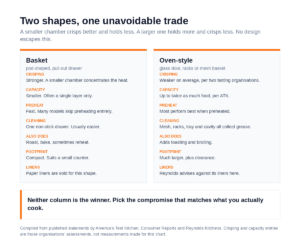
If you are comparing a basket appliance with an oven-shaped countertop model rather than a full-size oven, read basket vs oven-style air fryers. The capacity and crisping trade-off changes again.
Can you make a convection oven behave more like an air fryer?
Yes, within limits:
-
- Use convection mode rather than conventional bake.
-
- Use a perforated basket or low-sided pan so air can reach more of the food.
-
- Leave space between pieces; do not crowd the surface.
-
- Turn or rearrange the food partway through.
-
- Watch browning rather than trusting a fixed conversion formula.
America’s Test Kitchen recommends beginning about 25 °F lower when adapting a conventional recipe to convection, then changing course if the food spreads too much or browns too slowly. It also warns that some ovens automatically make this reduction. Check the manual before lowering the displayed temperature again.
Food safety does not change with the appliance name
Faster browning is not proof that the centre is safe. USDA says fish should reach 145 °F; whole cuts of beef, pork, veal and lamb 145 °F followed by a three-minute rest; ground meat 160 °F; and poultry 165 °F. Use a food thermometer.
The agency also warns not to cook raw stuffed breaded chicken-breast products in an air fryer and to follow the package instructions. That is a product-specific exception where the compact appliance is not automatically the safer shortcut.
What this comparison cannot tell you
-
- Whether your particular oven’s convection mode is slower than your particular air fryer. Fan speed and cavity design vary by model.
-
- A universal time conversion. Food shape, water content, thickness, load and appliance behaviour all change it.
-
- A universal electricity saving against convection. The strongest energy comparison we found does not disclose that its built-in oven was operating in convection mode.
-
- Which lasts longer. The sources here do not provide comparable durability data.
-
- Whether buying an air fryer will pay for itself. That depends on purchase price, local electricity rate, frequency of use and whether it replaces an oven cycle or adds another one.
Frequently asked questions
Is an air fryer just a small convection oven?
At the level of cooking method, yes. Both use forced convection. The meaningful differences are the smaller cavity, airflow speed and direction, heating-element layout, and perforated basket.
Does a convection oven make food as crispy as an air fryer?
It can come close with a perforated basket, space around the food and active convection. Independent evaluations still suggest that a dedicated air fryer generally has the advantage for maximum crispness in a small load.
Do I need an air fryer if my oven has convection?
No. Buy one only if you regularly cook small portions and value faster startup or stronger crisping enough to justify the cost and counter space. An existing convection oven already performs the same fundamental process.
Is air frying healthier than convection baking?
The appliance name does not create a health difference. Both can cook with little oil. The ingredients, quantity of oil and portion matter more than whether forced convection happens in a basket or oven cavity.
Which one is easier to clean?
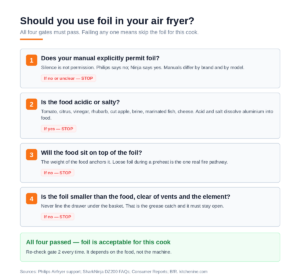
A removable basket is smaller and easier to reach, but it also concentrates grease close to the element. Liners can reduce basket mess without protecting the upper element. See our guides to liner safety and cleaning the heating element.
The decision in one sentence
Choose the air fryer when a small load and crisp surface matter most; choose the convection oven when capacity lets you finish the whole meal in one cycle.
Sources: America’s Test Kitchen, What Exactly Is Air Frying? (10 May 2023); America’s Test Kitchen, The Truth About Cooking with Convection (3 April 2019); Consumer Reports, Best Air Fryer Toaster Ovens (updated 1 January 2026); USDA FSIS, Air Fryers and Food Safety (updated 24 June 2024); Which?, Air Fryer vs Oven (19 June 2026); Energy Saving Trust (21 August 2025); and Whirlpool’s mechanical overview (4 August 2023). Whirlpool sells both air fryers and ovens; its page is used only for construction details, not as independent evidence of performance.