Is Air Fryer Non-Stick Coating Safe? PTFE, PFOA, and PFAS Explained
Last updated: August 3, 2026
Search for air fryer safety and you will find two confident answers. One says non-stick coatings release toxic chemicals into your food. The other says the whole concern is manufactured panic. Both are selling something — usually cookware.
The accurate answer is narrower than either, and it depends almost entirely on temperature and on the physical condition of the basket. This guide separates three acronyms that get used interchangeably but mean different things, sets out what food-safety regulators have actually published, and identifies the specific conditions under which the answer changes.
The short answer
An undamaged PTFE-coated air fryer basket, used within its normal temperature range, is not considered a meaningful source of dietary chemical exposure by the food-safety regulators that have assessed it. The coating is stable across the temperatures an air fryer can reach, and the thermostat prevents it from reaching the temperatures where it is not.
That sentence carries three qualifications, and every one of them matters:
- Undamaged. Deep scratches, flaking, and peeling change the situation — though not for the reason most articles claim.
- Within its normal temperature range. The known hazard from PTFE is airborne and occurs at temperatures well above what a working air fryer produces.
- Dietary exposure. Regulators assess what migrates into food. That is a narrower question than whether PFAS as a class are a concern, and the honest answer to the broader question is less reassuring.
If you want the practical version: the basket in your air fryer is very unlikely to be harming you today, the coating will wear out long before you stop using the appliance, and replacing it when it does is sensible for reasons that have little to do with toxicity.
Three acronyms that are not the same thing
Most of the confusion in this topic comes from articles using these three terms as synonyms. They are not.
| Term | What it is | Is it in your air fryer? |
|---|---|---|
| PTFE Polytetrafluoroethylene | The non-stick coating itself. A solid, chemically inert polymer. Teflon is a brand name for it. | Yes, in most non-stick baskets, unless the manufacturer specifies ceramic or bare stainless steel. |
| PFOA Perfluorooctanoic acid | A processing aid formerly used to manufacture PTFE. Not an ingredient of the finished coating. This is the substance behind the health litigation and news coverage. | Not in new cookware. It was phased out of production under a US EPA programme. |
| PFAS Per- and polyfluoroalkyl substances | The umbrella class of thousands of fluorinated chemicals. PTFE and PFOA are both members of it. | Yes — PTFE is itself a PFAS. This is why the labelling on many products is misleading. |
The distinction that matters most: PFOA is the substance with the documented human health record, and it is the one that is no longer used. PTFE is the substance still in your basket, and it behaves very differently — it is a large, stable, insoluble polymer rather than a mobile small molecule.
What happened to PFOA
The US Environmental Protection Agency ran the 2010/2015 PFOA Stewardship Program, under which it asked the eight major companies in the industry, in the agency’s own words, to commit to reducing PFOA from facility emissions and product content by 95 percent no later than 2010, and to work toward eliminating PFOA from emissions and product content no later than 2015.
All eight companies submitted commitments.
This is the origin of every PFOA-free sticker you have ever seen on a pan. The claim is true and also close to meaningless, because it describes an industry-wide change rather than anything specific about that product. More on why that label is actively misleading further down.
What food-safety regulators have published
On migration into food
The US Food and Drug Administration has authorised certain PFAS for use in food contact applications since the 1960s, and it groups those uses into four categories: non-stick coatings, sealing gaskets in food processing equipment, manufacturing aids, and grease-proofing agents for paper packaging.
The agency’s assessment separates these. Of the four categories, the FDA has stated that current data indicate only the paper and paperboard grease-proofing agents would result in dietary exposure at a level that may present a potential safety concern. Those grease-proofing substances are the ones the FDA announced in February 2024 are no longer being sold into the US market by manufacturers.
Non-stick cookware coatings are in a different category in that assessment. The FDA’s stated reasoning is that the coatings are polymerised — the molecules are bound together into large molecules and heat-bonded to the cookware — and that studies show the coating contains a negligible amount of PFAS capable of migrating into food.
You can read the agency’s own pages on authorised uses of PFAS in food contact applications and its questions and answers on PFAS in food. We note plainly that both FDA pages returned server errors when we attempted to load them directly for this article, so the summary above reflects the agency’s published positions as indexed rather than a page we were able to read end to end. If that distinction matters to you, open the links yourself.
On PFAS as a class
This is where the reassuring framing stops. In September 2020 the European Food Safety Authority published a scientific opinion setting a group tolerable weekly intake of 4.4 nanograms per kilogram of body weight per week for four PFAS that accumulate in the body: PFOA, PFOS, PFNA, and PFHxS.
EFSA identified the decreased response of the immune system to vaccination
as the most critical human health effect in determining that threshold, and stated that toddlers and other children are the most exposed groups.
Germany’s Federal Institute for Risk Assessment notes that based on the same EFSA calculation, long-term exposure to those four PFAS is above the tolerable weekly intake for roughly half of the adult population in Europe, and that intake relative to body weight can be significantly higher in children and adolescents.
Read those two sections together and the honest position emerges. PFAS exposure is a genuine public health issue. Your air fryer basket is not identified by these assessments as a significant contributor to it. EFSA lists the main dietary routes as drinking water, fish, fruit, eggs, and egg products — not cookware.
An article that tells you PFAS are harmless is wrong. An article that tells you your air fryer is dosing you with them is also wrong. Both errors come from collapsing the class into the coating.
The temperature question
The documented hazard from PTFE is not something it leaches into food. It is what it releases into the air when it is heated past the point where the polymer begins to break down.
The numbers that matter:
| Temperature | What happens |
|---|---|
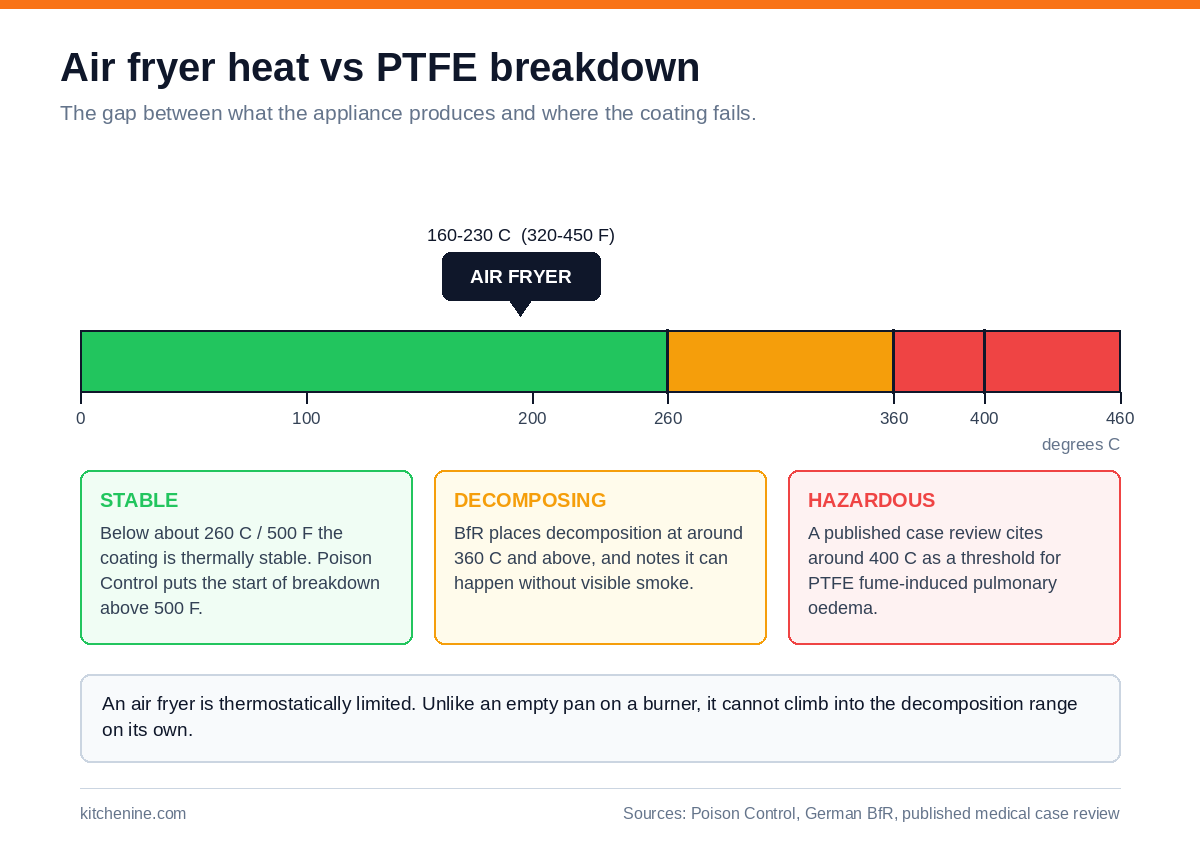
| Up to about 260 °C / 500 °F | PTFE is thermally stable. Poison Control states the coating starts to break down when exposed to temperatures above about 500 °F. |
| Around 360 °C and above | Germany’s BfR places decomposition here, and adds that hazardous substances can be released without visible smoke formation. |
| Around 400 °C | A published case review in the medical literature cites this region as a threshold for PTFE fume–induced pulmonary oedema. |
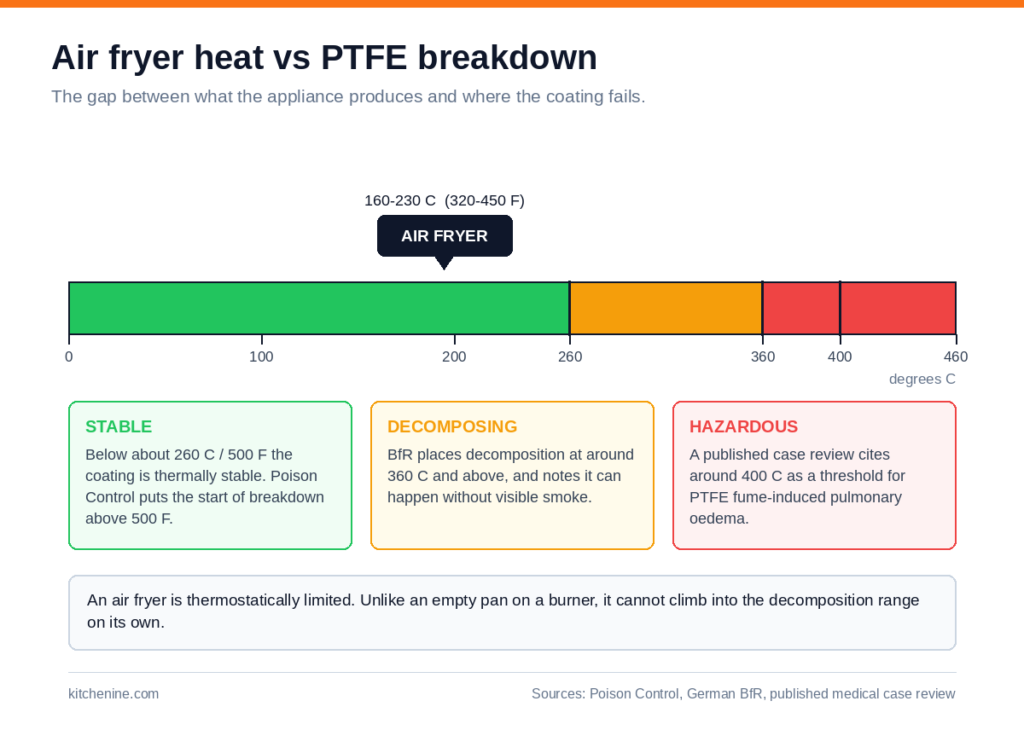
Now the appliance. Consumer air fryers commonly top out at 400 °F, with some models reaching 450 °F. That is roughly 205 to 230 °C. Most actual cooking happens well below the maximum.
The gap between the top of that range and the bottom of the decomposition range is not marginal. And critically, an air fryer is thermostatically limited — it holds a set temperature and cuts the element. This is the structural difference between an air fryer and an empty non-stick pan left on a gas burner, which has no upper limit and can pass 360 °C in minutes. Nearly every documented case of polymer fume fever involves a pan on a hob, not an oven-type appliance.
Two caveats we will not skip. Birds are extraordinarily sensitive to PTFE fumes and have died from cookware incidents at temperatures that caused no human symptoms; if you keep birds, keep them out of the kitchen regardless of appliance. And an air fryer with a failed thermostat is no longer a thermostatically limited appliance, which is one more reason to take a sudden acrid smell seriously rather than wait it out.
What about a scratched or peeling basket?
This is the question people ask most, and the common answer — that you are eating toxic flakes — is not what the evidence supports.
PTFE is biologically inert. Solid flakes that come off a scratched coating and end up in food pass through the digestive tract without being absorbed. This is not a fringe position; it is the standard toxicological description of the material, and it is why PTFE is used in implanted medical devices.
Poison Control does note that scratches in the coating can lead to fumes being released, which is a separate mechanism from ingestion and again a heat-dependent one.
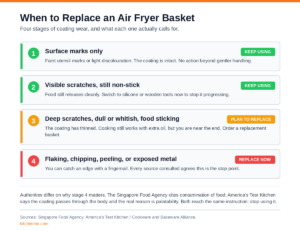
So should you replace a badly scratched basket? Yes — but be clear about why.
- A coating that is flaking is failing, and a failing coating exposes the substrate underneath, which you did not choose and the manufacturer did not intend as a food surface.
- Food sticks and burns onto bare patches, which produces the recurring smell and smoke problems that send people looking for answers in the first place.
- Damage that is visible is usually accompanied by damage that is not.
Replace it because it has stopped doing its job. That is a sufficient reason and it happens to be the accurate one.
Why “PFOA-free” does not mean what the packaging implies
Because PTFE is itself a PFAS, a product can be truthfully labelled PFOA-free while being coated in a fluoropolymer from the same chemical class.
Regulators noticed. Consumer Reports has reported that a California law taking effect in 2023 bars companies from claiming in online listings that a cookware product is free of any one PFAS — such as PFOA — if it contains any other PFAS, such as PTFE, with the same requirement extending to packaging in 2024 and a similar law in Colorado.
The practical reading rules:
- PFOA-free tells you almost nothing. It describes an industry-wide change from over a decade ago.
- PTFE-free is a specific, checkable claim about the coating.
- PFAS-free is the broadest claim and the one worth verifying against the manufacturer’s own material description, not the marketing headline.
- Non-toxic, healthy coating, and eco coating are not defined terms and tell you nothing at all.
Ceramic-coated air fryers
Ceramic non-stick is not pottery. It is typically a sol-gel coating — a silica-based layer cured onto the metal — and it genuinely contains no PTFE and no PFAS. If avoiding fluorinated chemicals in cookware is your goal, this is a real alternative rather than a marketing distinction.
Two honest qualifications.
First, durability is contested. The common claim that ceramic wears out much faster than PTFE is not well supported by standardised testing: the chemicals policy group ChemSec points to Stiwa abrasion testing, used in assessing cookware for the LGA quality mark, in which PTFE and ceramic coatings both score satisfactory-to-good and show similar non-stick lifetimes. Everyday reports are less flattering to ceramic, and we are not in a position to reconcile the two.
Second, coatings are only part of an air fryer. A ceramic basket does not change the heat-resistant plastics in the housing, the controls, or the handle. If your interest is specifically the food-contact surface, ceramic addresses it. If your interest is the appliance as a whole, it addresses one component.
Stainless steel and glass baskets avoid coatings entirely, at the cost of food sticking and harder cleaning.
What your manual actually tells you to do
The single most useful safety instruction on this topic is not about chemistry. It is about how you clean the basket, and almost nobody follows it.
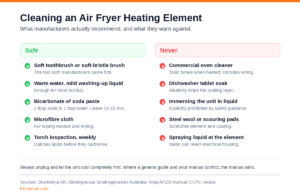
The Ninja AF100 series owner’s manual, in its Important Safeguards, instructs: DO NOT clean with abrasive cleaners, steel wool, or scouring pads.
Every scouring pad taken to a non-stick basket is the mechanism that creates the scratched coating people then worry about. The damage that generates the concern is, in most kitchens, self-inflicted during washing. The same manual directs owners to wash the basket and crisper plate in hot soapy water, rinse, and dry thoroughly.
Metal utensils do the same thing more quickly. Silicone and wood do not.
Your own manual takes precedence over this article. Models differ, and some manufacturers specify maximum temperatures or cleaning products for their particular coating.
What this guide cannot tell you
We think you are better served by an explicit list of limits than by a confident tone.
- We have not tested any air fryer for chemical migration. That requires an accredited laboratory, and no consumer publication that is not commissioning laboratory work can honestly claim otherwise.
- We cannot tell you what coating is on your specific model. Manufacturers describe coatings inconsistently and some do not disclose the formulation at all. The manual or the manufacturer’s support line is the only reliable route.
- We cannot tell you whether your basket is damaged enough to replace. Photographs on the internet do not substitute for looking at yours.
- The regulatory position is moving. Several jurisdictions are restricting PFAS in consumer goods, and assessments published after this article may supersede the figures above. The tolerable weekly intake for PFOA alone changed from 1,500 ng/kg per day in 2008 to 6 ng/kg per week in 2018 to a grouped 4.4 ng/kg per week in 2020. Anyone claiming this science is settled is not following it.
- We cannot advise you on medical concerns. If you have inhaled fumes from overheated cookware and have symptoms, contact a poison control centre or a doctor.
Frequently asked questions
Can an air fryer get hot enough to break down its non-stick coating?
Not under normal operation. Consumer air fryers top out around 400 to 450 °F (roughly 205 to 230 °C), and the coating is stable to about 500 °F, with the decomposition figures cited by BfR and the medical literature considerably higher again. The thermostat is the reason the gap holds. A malfunctioning unit is a different situation, which is why an acrid smell warrants stopping.
I ate food from a scratched basket. Should I be worried?
PTFE is inert and is not absorbed by the digestive tract; flakes pass through. The reason to replace a flaking basket is that the coating has failed, not that a swallowed flake poisons you. If you have specific health concerns, ask a doctor rather than an article.
Is a ceramic air fryer genuinely safer?
It genuinely avoids PTFE and PFAS in the food-contact coating, which is a real difference rather than a marketing one. Whether that translates into a health benefit for you depends on a migration risk that regulators currently assess as negligible for undamaged PTFE. It is a reasonable choice on precautionary grounds; it is not a correction of a documented harm.
Does “PFOA-free” mean the air fryer has no PFAS?
No. PTFE is itself a PFAS, so a PFOA-free product can be PFAS-coated. This gap is precisely what the California and Colorado labelling laws reported by Consumer Reports were written to close. Look for PTFE-free or PFAS-free instead.
Should I throw out my current air fryer?
Nothing in the published regulatory assessments supports discarding a functioning appliance with an intact basket. If the coating is flaking, replace the basket where the manufacturer sells one, or the unit where it does not. Replacing working equipment on the strength of a headline is a cost, not a safety measure.
Related reading
- Why Does My Air Fryer Smell Like Plastic — and Is It Dangerous?
- When Should You Replace an Air Fryer Basket?
- How to Clean an Air Fryer Heating Element
- Why Is My Air Fryer Smoking?
Sources for this article include the US EPA PFOA Stewardship Program fact sheet, the EFSA 2020 scientific opinion on PFAS in food, the German BfR questions and answers on PTFE-coated cookware, Poison Control on polymer fume fever, and manufacturer documentation. Our approach to sourcing is described in How We Research.