Air Fryer Features That Actually Matter
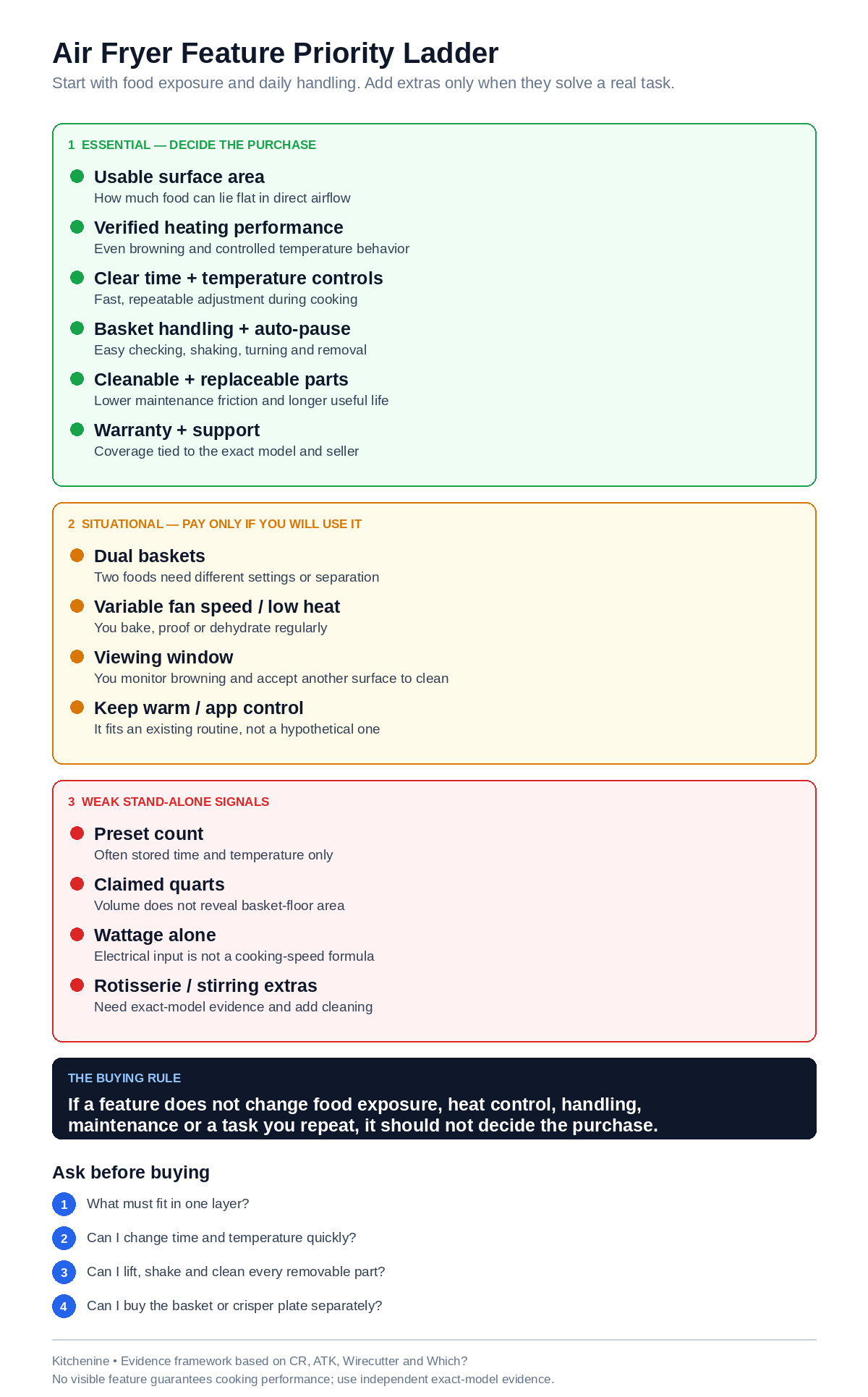
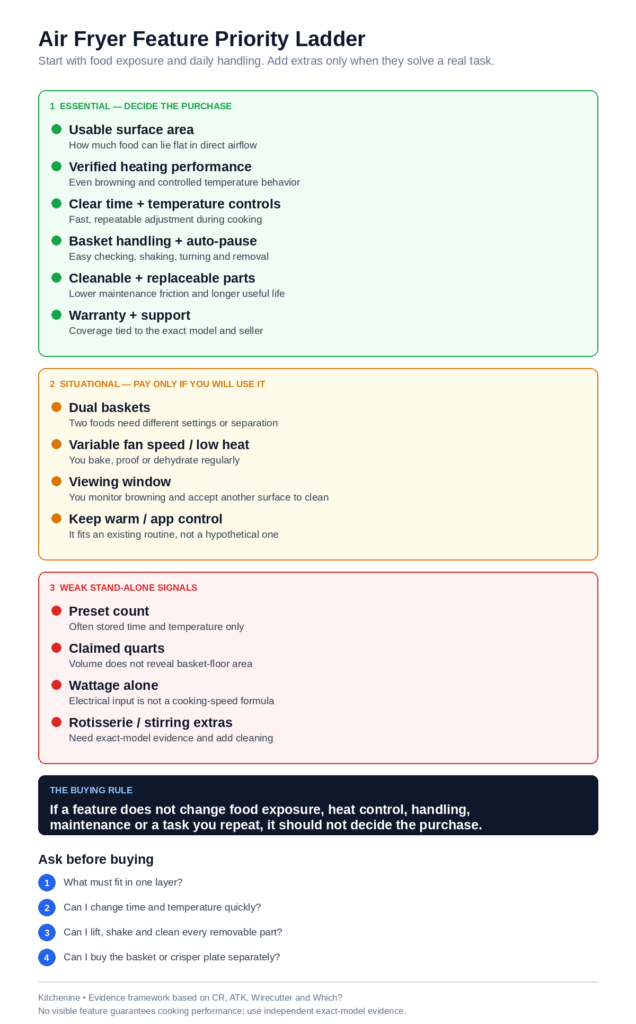
The air fryer features that matter most are usable cooking surface, documented heating performance, clear controls, easy basket handling, practical cleaning, replaceable parts and a meaningful warranty. Features such as dozens of food presets, app control and a large quart number may be useful, but they do not prove that an appliance cooks evenly or fits more food in a single layer.
Start with what you cook and how much of it must lie flat. Then evaluate independent performance evidence and daily handling. Only after those questions are answered should extra modes influence the purchase.
The feature priority list
| Priority | Feature | Why it matters |
|---|---|---|
| Essential | Usable surface area | Determines how much food can receive direct airflow in one layer |
| Essential | Verified heating performance | Controls browning, speed and consistency |
| Essential | Clear time and temperature controls | Makes recipe adjustment fast and repeatable |
| Essential | Safe, easy basket handling | You must remove, shake, turn and clean it regularly |
| Essential | Cleanable, replaceable food-contact parts | Reduces friction and extends useful life |
| Essential | Useful warranty and support | Matters when a fan, sensor, coating or control fails |
| Situational | Two zones, window, low fan speed | Valuable only for specific cooking patterns |
| Low evidence | Preset count, wattage or quarts alone | Easy to market but weak as stand-alone performance signals |
1. Usable surface area matters more than claimed quarts
Air frying works by moving hot air over food. Pieces crisp most predictably when arranged in a shallow layer with space for circulation. The floor of the basket therefore matters more than empty height above the food.
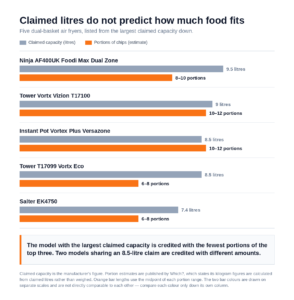
America’s Test Kitchen reports that width mattered more than height because food cooks best in one layer. Its preferred larger baskets provided cooking surfaces greater than 10 by 10 inches. Consumer Reports separately warns that measured usable capacity is often smaller than the manufacturer’s quart claim.
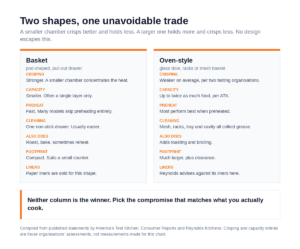
A tall, narrow six-quart basket can be less useful for cutlets than a lower, wider basket with the same stated volume. Square or rectangular floors also use counter depth more efficiently than round baskets for foods that need to lie flat.
What to measure
- Internal width and depth at the crisper plate.
- How many of your usual cutlets, fillets or vegetable portions fit without stacking.
- Whether the basket narrows substantially toward the bottom.
- External depth including the handle and required rear clearance.
If a product page lists only quarts, look for a manual, interior dimensions or an independent capacity measurement. Use what size air fryer do you need? to translate your normal portions into basket requirements.
2. Heating performance matters—but the specification sheet rarely proves it
An air fryer’s job is not merely to draw power. It must bring the chamber to a useful temperature, move heat across the food and control element cycling well enough to avoid a basket of scorched and pale pieces.
Wirecutter checks whether models reach and maintain selected temperatures, then compares browning and moisture across common foods. Consumer Reports evaluates controls, noise and cleaning, while Which? adds cooking speed, energy use and food quality. These results reveal more than a wattage number.
Why wattage alone is weak evidence
Wattage is maximum electrical input. It does not disclose chamber size, fan design, element cycling or how much heat reaches the food. A high-wattage large appliance can heat more metal and air than a lower-wattage compact model.
Look for comparative cooking results, temperature behaviour and speed under matched conditions. Read why cooking times vary between air fryer models before treating watts as a minutes-to-doneness formula.
3. Simple time and temperature controls beat a long preset menu
Food thickness, load and starting temperature change the required cook. A button labelled “chicken” cannot know whether the basket contains two thin refrigerated cutlets or four thick frozen portions.
The controls that matter are:
- a display that remains readable at your normal standing angle;
- time and temperature adjustments that require few steps;
- increments fine enough for the recipes you use;
- buttons, dial or touchscreen that responds reliably;
- the ability to adjust time or temperature during cooking; and
- a clear signal when the cycle ends.
America’s Test Kitchen preferred simple, responsive digital controls, while Consumer Reports evaluates how intuitive buttons, dials and displays are. Digital is not automatically better: physical controls may be easier for greasy fingers or limited dexterity, while a good digital dial can offer more precise adjustment than two analog knobs.
Preset count belongs near the bottom of the comparison sheet unless a mode changes more than default time and temperature.
4. Basket handling affects every cook
Most foods need to be checked, shaken or turned. That makes the handle, drawer rails, crisper plate and pause behaviour more important than they appear in a product photo.
America’s Test Kitchen preferred drawer-style baskets with a large handle because they were easier to manoeuvre and kept hands away from the heating element. It also valued auto-pause: removing the drawer stopped the countdown, and replacing it resumed the same cycle.
Check these details in person or on video
- Does the basket slide without requiring a hard shove?
- Can the loaded drawer be lifted with one hand?
- Does the crisper plate stay in place when food is poured out?
- Does removing the basket pause, reset or continue the timer?
- Are there exposed sharp edges or small crevices that trap food?
A viewing window does not eliminate the need to turn food, check internal temperature or clean the chamber. It is convenient, not a substitute for usable handling.
5. Cleaning design is a performance feature
Grease and crumbs accumulate where air moves. If cleaning requires multiple racks, hinges, mesh cages and narrow channels, maintenance is more likely to be delayed. That can contribute to smoke, odour and restricted airflow.
Consumer Reports makes cleaning a scored part of its evaluation. Which? notes that the appliance must be cleaned after use and treats dishwasher-safe removable parts as a practical advantage. America’s Test Kitchen found oven-style racks and bases harder to clean than drawer baskets in its comparison.
Dishwasher-safe does not mean maintenance-free
Read the exact manual. Some baskets are labelled dishwasher-safe, but repeated dishwasher exposure can still affect appearance or coating life. A basket that fits easily in your sink and releases residue with a soft sponge may be more convenient than a larger “dishwasher-safe” drawer that occupies an entire rack.
Inspect whether the crisper plate lifts out without tools and whether its feet or bumpers can be replaced. Avoid designs with sharp mesh that catches sponges or makes both sides difficult to reach.
6. Replacement parts and coating disclosure matter more than a color choice
The basket and crisper plate are wear parts. Before buying, search the manufacturer’s support or parts store for the exact model. Confirm whether a replacement basket, plate, handle bumper or rack can be purchased separately.
A low-cost air fryer can become disposable if the food-contact surface is scratched and no replacement exists. Wirecutter gives replacement-part availability weight in its recommendations for this reason.
Coating labels also require precision. “PFOA-free,” “PTFE-free,” “PFAS-free” and “ceramic-coated” are not interchangeable. Look for a statement tied to the exact model and food-contact parts, not a brand-wide assumption. See air fryer non-stick coating safety for the terminology and limits.
7. Warranty length and support are functional features
Consumer Reports found warranty periods ranging from 60 days to three years among evaluated air fryers. The number matters, but coverage details matter more.
- Does coverage begin at purchase or registration?
- Is proof of purchase required?
- Are basket coatings treated as normal wear?
- Does the buyer pay return shipping?
- Does buying from a marketplace seller affect eligibility?
- Are support contact details and model manuals still available?
Save the receipt, manual and model label photo. A long warranty is not useful if the seller is unauthorised or the owner cannot identify the exact revision.
Features that matter only for specific buyers
| Feature | Worth paying for when… | Skip it when… |
|---|---|---|
| Dual baskets | You frequently cook two foods at different settings | You mostly make one large batch and need maximum single-layer area |
| Variable fan speed | You bake, dehydrate or cook delicate foods as well as crisp | Every mode uses fixed airflow and you only reheat or crisp |
| Low temperature range | You genuinely dehydrate, proof dough or hold food | You only air-fry at conventional high temperatures |
| Viewing window | You monitor browning often and the window remains easy to clean | It reduces usable space or adds a dirty crevice |
| Auto-pause | You shake or check most cooks | You are comfortable pausing and resuming manually |
| Keep warm | Meal components finish at different times | You serve immediately and value simpler controls |
| App control | Remote status and saved recipes fit your routine | Connectivity adds steps without changing cooking performance |
Variable fan speed can be real—but verify what changes
Some modes change only time and temperature; others also change fan speed. Cosori’s TurboBlaze, for example, documents five function-linked fan speeds, using gentler airflow for proofing or dehydrating and higher airflow for crisping. The speeds are not freely adjustable on that model.
Ask whether fan speed is user-selectable, automatically linked to a mode or simply marketing language. This feature is valuable for a buyer replacing several appliances, but unnecessary for frozen fries and leftovers.
Dual baskets solve scheduling, not physics
Two zones are useful when a main and side require different settings or when meat and vegetarian food must remain separate. They can also divide available heating power and countertop area. Compare each drawer’s floor dimensions, not only total combined quarts.
The next article in this series examines that decision in detail: is a dual-basket air fryer worth it?
Features that are often overvalued
Dozens of food presets
A preset is usually a stored starting point. Unless it changes fan speed or another physical behaviour, manual time and temperature controls can reproduce it. Presets do not sense food thickness, weight or frozen state.
A large quart claim
Quarts describe volume, not the single-layer surface needed for browning. Independent measurements repeatedly find differences between claimed and usable capacity.
High wattage by itself
Higher input does not guarantee faster or more even cooking. Chamber size, airflow and control cycling determine what reaches the food.
Rotisserie and automatic stirring accessories
America’s Test Kitchen found the evaluated rotisserie and auto-stir attachments fussy and not consistently better. Extra parts also require storage and cleaning. Buy them only when independent evidence covers the exact attachment and the foods you plan to cook.
Oil-reduction percentages
A percentage depends on the comparison food and method. It does not reveal cooking evenness, basket size or whether the food was already pre-fried. Treat it as a marketing claim unless the test method is disclosed.
A 10-minute store or product-page test
- Map one meal. List the largest food pieces and quantity you cook most often.
- Check the floor. Find internal width and depth, not only quarts.
- Measure the counter. Include handle depth, open-drawer space and vent clearance.
- Simulate a change. Count the steps needed to add two minutes or lower temperature during cooking.
- Inspect the basket. Check weight, handle grip, crisper-plate retention and sharp edges.
- Trace the cleaning path. Count removable pieces and look for inaccessible seams.
- Search exact-model parts. Look for a basket and crisper plate before purchase.
- Open the warranty. Check term, seller eligibility and shipping obligations.
- Read independent performance evidence. Reject conclusions based only on specifications or customer stars.
- Delete unused extras. Do not pay more for a mode you cannot name a weekly use for.
Frequently asked questions
How many quarts should an air fryer have?
There is no universal household-to-quart conversion. Measure the food that must lie flat. A wide four- or five-quart basket can be more useful than a narrow six-quart basket.
Are digital controls better than manual dials?
Digital controls can offer finer adjustment and a clearer countdown. Manual dials can be faster and easier to operate. Responsiveness, readability and adjustment steps matter more than the control type.
Is a viewing window worth it?
It is useful for monitoring browning, but not essential. Check whether the window reduces basket area, loses heat, becomes greasy or adds difficult seams.
Do air fryer presets change how the machine cooks?
Sometimes. Many store only a default time and temperature. Some also select a fan speed. The manual should state what each mode controls.
What feature most improves crisping?
No single visible feature guarantees crisping. Prioritise a wide single-layer cooking surface and independent evidence of strong, controlled heating and even browning.
Bottom line
Buy an air fryer around the basket floor and your routine—not the control-panel vocabulary. A model with wide usable area, reliable heat, clear controls, secure handling, simple cleaning, available parts and credible support has the features that matter.
Dual zones, windows, low-temperature modes and variable fan speeds can be worthwhile when they solve a repeated task. Preset count, wattage and claimed quarts should never decide the purchase alone.
Sources: Consumer Reports, How to Pick the Perfect Air Fryer (updated November 20, 2025); America’s Test Kitchen, The Best Air Fryers (updated January 15, 2026); Wirecutter, The Best Air Fryers of 2026; Which?, Best Air Fryers 2026 (updated July 1, 2026); and Cosori TurboBlaze product documentation for its model-specific fan-speed implementation. Cosori is a manufacturer; its page is used only to document what that model’s functions control.