When Should You Replace an Air Fryer Basket?
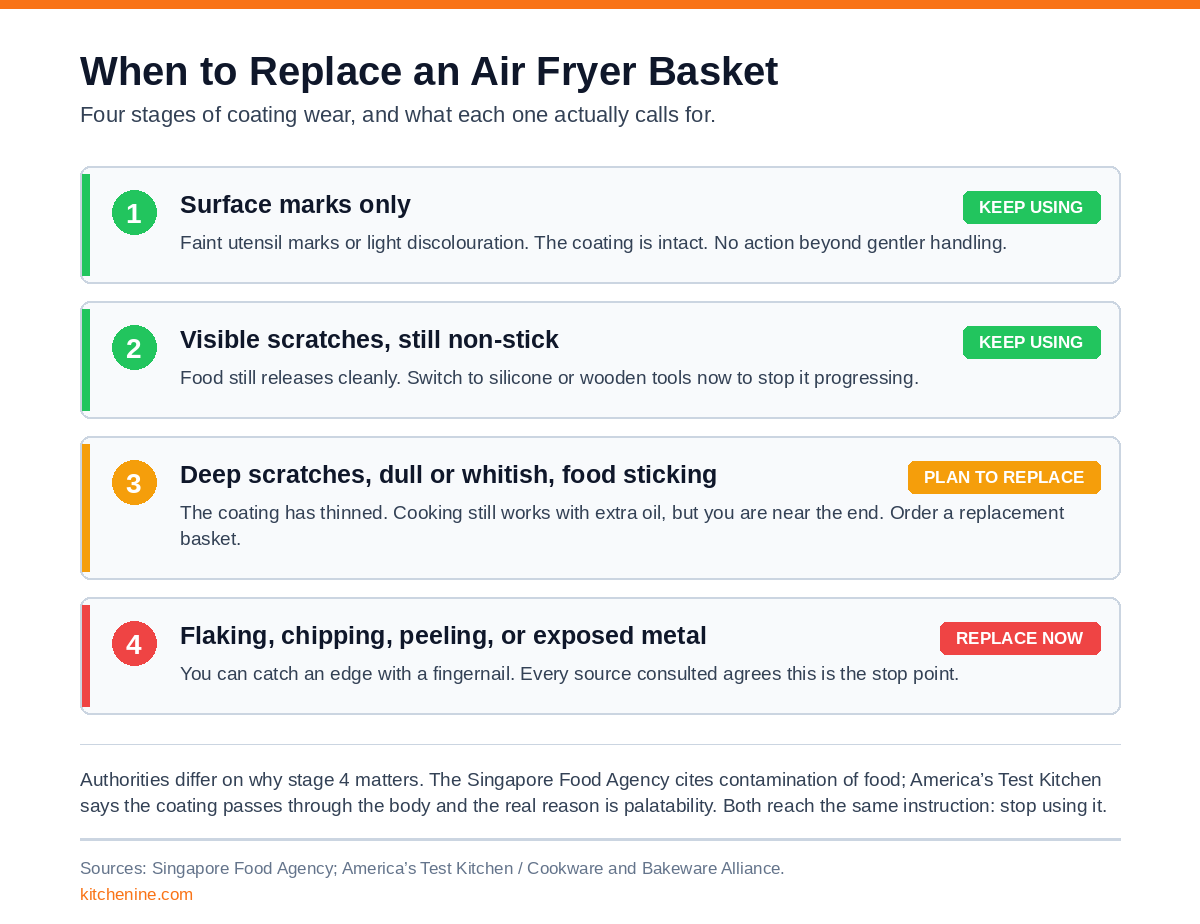
Replace the basket when the coating is flaking, chipping, peeling, or has worn through to bare metal. Scratches alone are not the trigger. Neither is discolouration.
That is the short version, and every source we consulted agrees on it. Where they disagree — sharply — is on why it matters. That disagreement is worth understanding, because it changes how urgently you should act.
The four stages of wear
| Stage | What you see | What to do |
|---|---|---|
| 1 | Faint utensil marks, light discolouration. Coating intact. | Keep using it. Handle more gently. |
| 2 | Visible scratches, but food still releases cleanly. | Keep using it. Switch to silicone or wooden tools now. |
| 3 | Deep scratches, surface looks dull or whitish, food sticks. | Order a replacement. You are near the end. |
| 4 | Flaking, chipping, peeling, or exposed metal. | Stop using it. |
The practical test for stage 4 is your fingernail. If you can catch an edge of coating and lift it, the surface is no longer stable.
Stage 3 is the one people misjudge. America’s Test Kitchen describes the signal precisely: If the surface is looking whitish and dry, it’s likely that the nonstick coating has worn away to an extent that will make it quite clingy.
The basket still works. It just works badly, and it is on a one-way trip to stage 4.
Where the authorities genuinely disagree
This is the part most articles on this topic paper over, so we will not.
The Singapore Food Agency, a government food safety regulator, states plainly that Using a pan with damaged coating can cause your food to be contaminated by PFAS, micro- and nanoplastics.
Its instruction follows directly: Replace old cookware when the coatings start to visibly deteriorate with excessive scratches, peeling, flaking, and chipping.
America’s Test Kitchen reaches the same instruction from the opposite premise. On flaking coatings it says to throw the pan out — but adds: Not for safety reasons—the coating won’t interact with your body and will pass right through if accidentally ingested. (This is why nonstick is used to coat surgical implants and sutures.)
Its stated reason is that it’s unpleasant to eat bits of coating.
Wirecutter lands between them, judging that the health risks from using a scratched nonstick pan are lower if the pan is used at the recommended low-heat temperatures
, while still recommending you stop using a nonstick pan that is heavily scratched or that is no longer nonstick.
So: a food safety regulator says contamination, a testing kitchen says inert but unpalatable, and a review outlet says low risk at low heat. We are not in a position to resolve that, and we are not going to pretend the question is settled.
What matters practically is that all three arrive at the same action. When the coating starts coming off, stop using the basket. You do not need to know which body is right to follow the instruction they share.
Why an air fryer basket is not quite a frying pan
Most published guidance on non-stick wear is written about stovetop pans, and one difference matters.
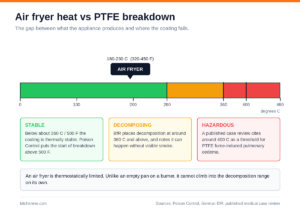
The Singapore Food Agency’s temperature warnings are about direct-flame cooking: PTFE can start to produce fumes
above 260 °C, and beyond 350 °C the coating begins to break down to release harmful gases that can even be lethal in extreme cases.
Its central safety advice is not to preheat an empty pan, because an empty pan on a burner has nothing absorbing the heat.
An air fryer is thermostatically limited and tops out around 200 °C, well under that threshold. That is a meaningful safety margin a frying pan does not have, and we covered the full picture in is air fryer non-stick coating safe.
The trade-off runs the other way on abrasion. Baskets get crisper plates dropped into them, tongs dragged across them, and aggressive scrubbing after greasy cooks. Mechanical wear, not heat, is what usually kills an air fryer basket.
How long should it last?
Published estimates vary widely, and they are all about pans rather than baskets.
| Source | Estimate | Scope |
|---|---|---|
| Cookware and Bakeware Alliance, via America’s Test Kitchen | 5 to 7 years with a quality coating | Non-stick pans |
| America’s Test Kitchen, on older technology | 2 to 3 years | Non-stick pans, a decade ago |
| Wirecutter | About 3 to 5 years | Non-stick pans |
Treat these as loose reference points, not a schedule. America’s Test Kitchen puts the caveat bluntly: How you treat your nonstick pan will ultimately determine how long it lasts.
A basket cleaned gently with silicone tools will outlast one scrubbed with a scourer several times over, and no calendar figure captures that.
Inspect the surface instead of counting years.
Ceramic or PTFE — which wears faster?
Our sources contradict each other here too, and we flagged the same conflict in our coating safety guide.
America’s Test Kitchen: Typically, ceramic pans wear faster but both styles are fallible.
Wirecutter agrees, noting ceramic coatings typically degrade even faster than PTFE.
ATK also observes that chipping is more common in ceramic nonstick pans.
Against that, an abrasion test conducted for ChemSec using the Stiwa method found PTFE and ceramic coatings achieving broadly similar lifetimes.
One is laboratory abrasion testing, the others are accumulated observation from testing kitchens. They are measuring different things and we cannot reconcile them. If your basket is ceramic-coated, watch it a little more closely than the lab result alone would suggest.
Replace the basket, or the whole appliance?
Check for a genuine replacement basket before writing off the unit. Manufacturers do sell them: SharkNinja, for example, lists a replacement ceramic-coated non-stick basket on its own site, specified as compatible with a named list of five model numbers.
That model list is the important detail. Baskets are not interchangeable between models, and fit matters for airflow as well as for the drawer sealing properly. Buy the part specified for your exact model number, which is printed on the rating label underneath the appliance.
Replace the whole unit instead when the housing is damaged, the cord is compromised, or the fault is electrical rather than cosmetic. If your appliance is smoking, do not assume the basket is the answer — work through why is my air fryer smoking first, because burnt grease on the heating element causes far more smoke than a worn basket ever will.
What actually shortens basket life
- Metal utensils. The Singapore Food Agency is direct:
Use wooden, silicone, or plastic utensils instead of metal utensils to avoid scratching the non-stick coating.
- Abrasive cleaning.
Avoid using steel wool or scouring pads to avoid scratching the coating.
Ninja’s own manual carries the same prohibition. - Aerosol cooking sprays. LSU AgCenter’s air fryer publication instructs users not to use nonstick cooking sprays, warning these contain additives that could harm the appliance. Wirecutter reports the same problem from the wear angle — spray residue
builds up over time and makes your pan prone to sticking.
Use a refillable mister with plain oil. - The dishwasher. Wirecutter advises against it even for dishwasher-safe items, and SharkNinja notes that high-heat cycles and aggressive detergents cause premature wear.
- Letting grease carbonise. Baked-on residue demands harder scrubbing, which is what does the damage. Regular gentle cleaning is preventative — see how to clean an air fryer heating element.
What this guide cannot tell you
- Whether ingesting coating flakes is harmful. The Singapore Food Agency and America’s Test Kitchen take opposing positions and we have not found evidence that settles it.
- How long your basket will last. Every published figure is for stovetop pans, and usage dominates the outcome.
- Whether a specific replacement basket fits your model. Only the manufacturer’s compatibility list can answer that.
- Whether re-coating sprays work. We found no manufacturer or regulator endorsing DIY re-coating for food-contact surfaces, so we are not going to recommend it.
- We were unable to load Columbia University’s health guidance on ingesting PTFE flakes — the page returned a server timeout — so the two positions above are presented without that third voice.
Frequently asked questions
Is one scratch dangerous?
No source we consulted treats an isolated scratch as a reason to stop cooking. The Singapore Food Agency’s threshold is excessive scratches, peeling, flaking, and chipping
— note the word excessive. Wirecutter’s position is that PFAS exposure builds from many sources over time
rather than from a single scratched pan.
Can I line the basket instead of replacing it?
A liner covers the base, not the sides, and reduces air circulation. It is a workaround for stage 3, not a fix for stage 4.
My basket is discoloured but smooth. Replace it?
No. Discolouration from repeated heating is cosmetic. Texture is the signal, not colour.
Are PFOA-free baskets exempt from this?
PFOA-free is not PFAS-free. Wirecutter notes PFOA and PFOS have not been used in PTFE coatings since 2014, and that newer replacement chemistries are still being studied.
The replacement advice is unchanged.
Can a worn basket cause smoking?
Rarely. Food sticking and burning in a bare patch can produce some smoke, but grease on the heating element is a far more common cause.
Related reading
- Is air fryer non-stick coating safe?
- How to clean an air fryer heating element
- Why is my air fryer smoking?
- Why does my air fryer smell like plastic?
Sources: Singapore Food Agency, Safe Practices for Non-Stick Pans, 2 July 2023; America’s Test Kitchen, How Often Should I Replace My Nonstick Pan?, 16 August 2023; Wirecutter, How Bad Are Scratched Nonstick Pans for You?; ChemSec, Stiwa abrasion testing; LSU AgCenter publication P3853. Our method is described in how we research.